OCTOBER 2025
Hong Kong Baptist University
C.B. Fisk Inc.
Gloucester, Massachusetts
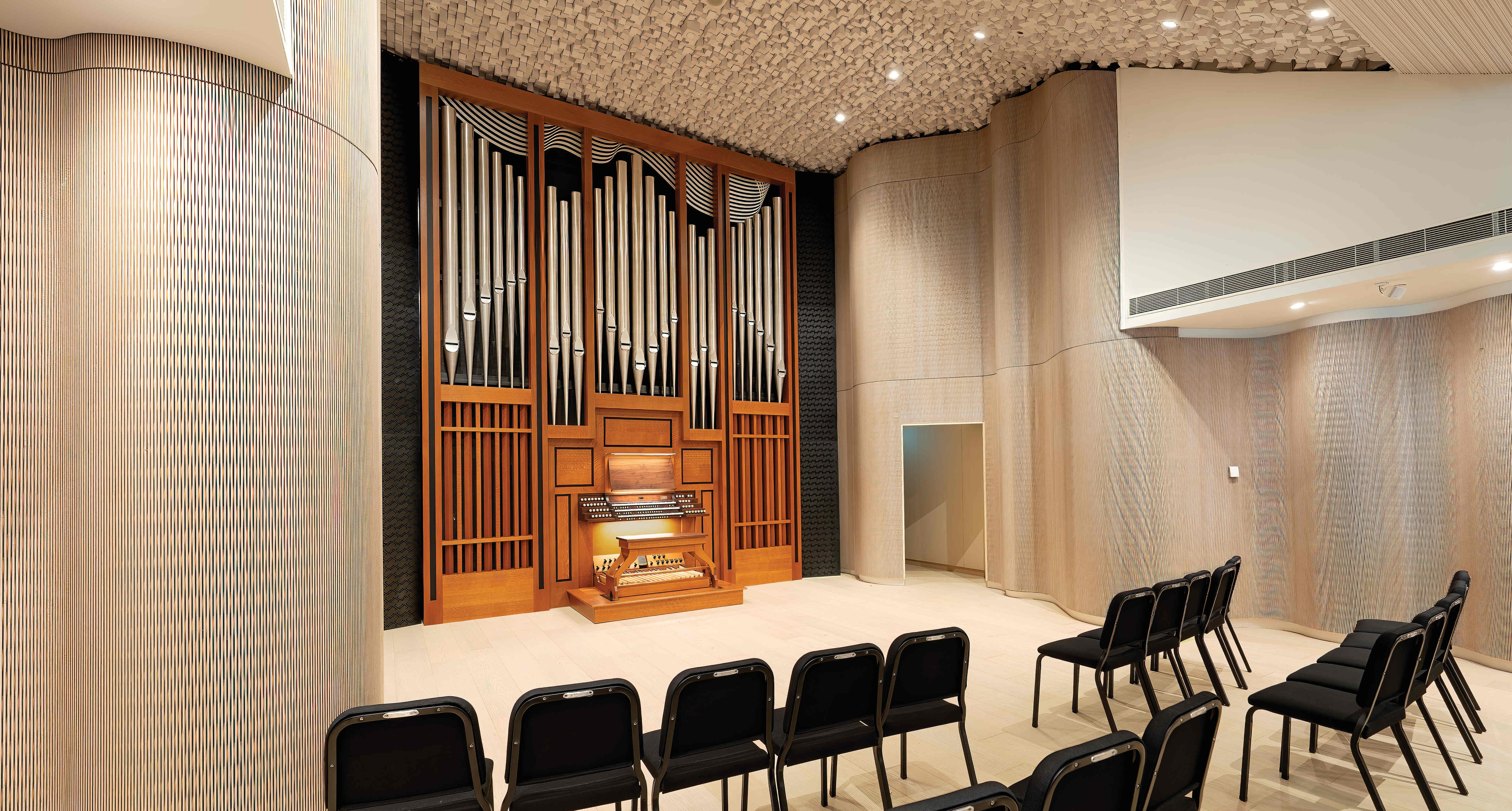
The organ is situated in the Activity Room of the newly completed JC3 building.
Hong Kong Baptist College was founded by the Baptist Convention of Hong Kong in 1956 as a postsecondary college committed to offering holistic education to its students. By 1983 the college had become a fully funded public institution; just over a decade later, in 1994, it attained university status, at which point it was renamed Hong Kong Baptist University. As one of Asia’s finest institutions of higher learning, HKBU, located in Kowloon Tong, is dedicated to providing its approximately 7,500 undergraduate and nearly 5,000 graduate students a broad-based, transdisciplinary education.
In 2014 the Hong Kong AGO Chapter was formally launched. According to its website (AGOHK.org), the chapter “is committed to [encouraging] excellence in the performance of the organ and to [nurturing] future generations of organists. In addition, it collaborates with international organ organizations . . . to promote cross-cultural exchanges in organ music.” All worthy principles indeed—but it doesn’t end there. Devotees are making a concerted effort to facilitate the acquisition of quality instruments for the Hong Kong organ community. As an example, in 2016, C.B. Fisk was commissioned to build an instrument for the SKH (Sheng Kung Hui, or Anglican Church) Tang Shiu Kin Secondary School Chapel in Hong Kong’s Wan Chai district. Opus 149—a three-manual, nine-stop tracker—is used to accompany chapel services and is available as a practice and teaching instrument.
Five years later, Fisk was approached about another project. This time, we were asked to make proposals for two organs—one a teaching and performance instrument, the other a practice organ—for Hong Kong Baptist University. The school was aiming to create a new building, and space was to be provided for two mechanical-action pipe organs. Branded the Jockey Club Campus of Creativity (JC3), this cutting-edge facility would include a multipurpose Activity Room to serve as a gathering place for students, a concert venue for small ensembles, and an organ teaching and performance room. Additionally, a room of suitable scale was being planned to house a practice organ. Acoustical design proposals for both spaces, with input from the organbuilder, were to be specified.
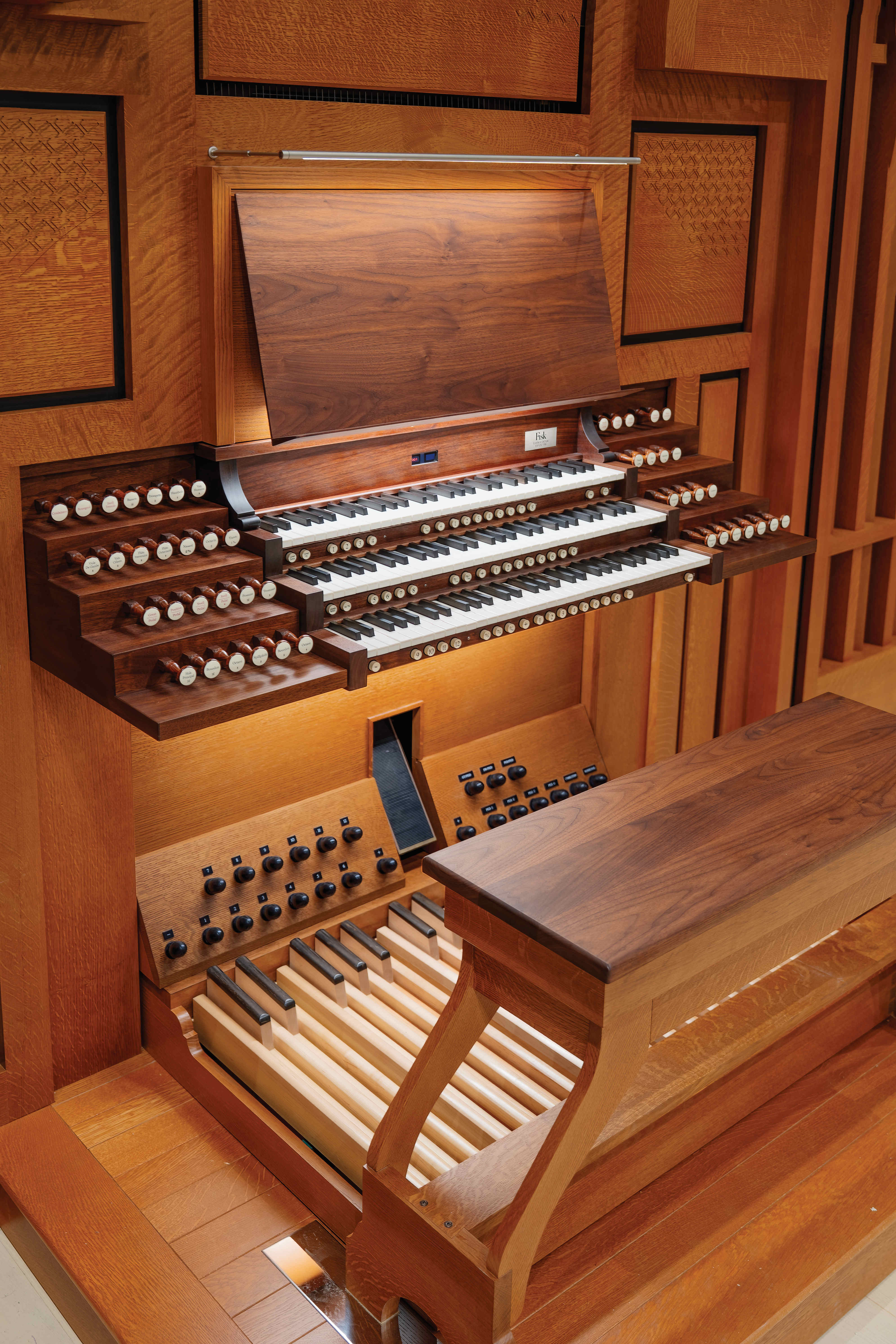
Natural key covers are of bone, with ebony sharps.
Thus, in November 2019 we generated preliminary specifications for a 30-stop, three-manual teaching/performance instrument and a seven-stop, three-manual practice organ. With regard to the first, it was stated from the outset that a French-biased specification was preferred in order to complement the German-built organs already present in Hong Kong. Preliminary discussions about the organs’ designs involved Johnny Poon, the H.S. Hung Endowed Professor in Music at HKBU. Generally speaking, his advice was to keep creativity and innovation at the forefront of our thinking. He was particularly interested in the collaborative possibilities between organists and other musicians in a variety of configurations. He showed a specific interest in the potential for improvisation. And finally, he wondered if the interior of the performance organ could be made accessible to students, offering them the opportunity to gain an understanding of its inner workings.
Following a lengthy commissioning process with HKBU, C.B. Fisk was awarded the contract for both organs in December 2020. The building would be home to Fisk Opus 158 (teaching/performance instrument) and Opus 159 (practice organ). January 2021 saw the beginning of an extended series of virtual design conferences. At a distance of twelve time zones, these strategy sessions involved HKBU architects, engineers, and acousticians as well as Fisk visual, tonal, and mechanical designers. Eventually, we brought our own acoustical consultant into the mix as well.
With an initial focus on achieving good bass-to-treble balance and reducing potential for acoustic distortion, both rooms underwent extensive and thoughtful modification in design. Many ideas were put on the table by both parties—some accepted, others rejected. In the multipurpose Activity Room, the ceiling over the organ was raised 20 inches (to 20′ 8″) in order to offer the organ more visual and tonal breathing room; specific wall sections were fortified for bass tone retention and projection; and super-diffusive surface treatments were specified for critical stretches of the ceiling. For the sake of noise reduction, the proposed fan coil units along the upper perimeter of the Activity Room were eliminated and replaced with a single remote air handler and accompanying ductwork. To keep sound permeation in both directions to a minimum, the architect’s “acoustic layer” enveloping the room was bolstered to include a double layer of high-density cement board. Curvilinear wooden screens cover the rear wall and one side wall (the other side wall is glass with retractable curtains), introducing more provision for diffusion.
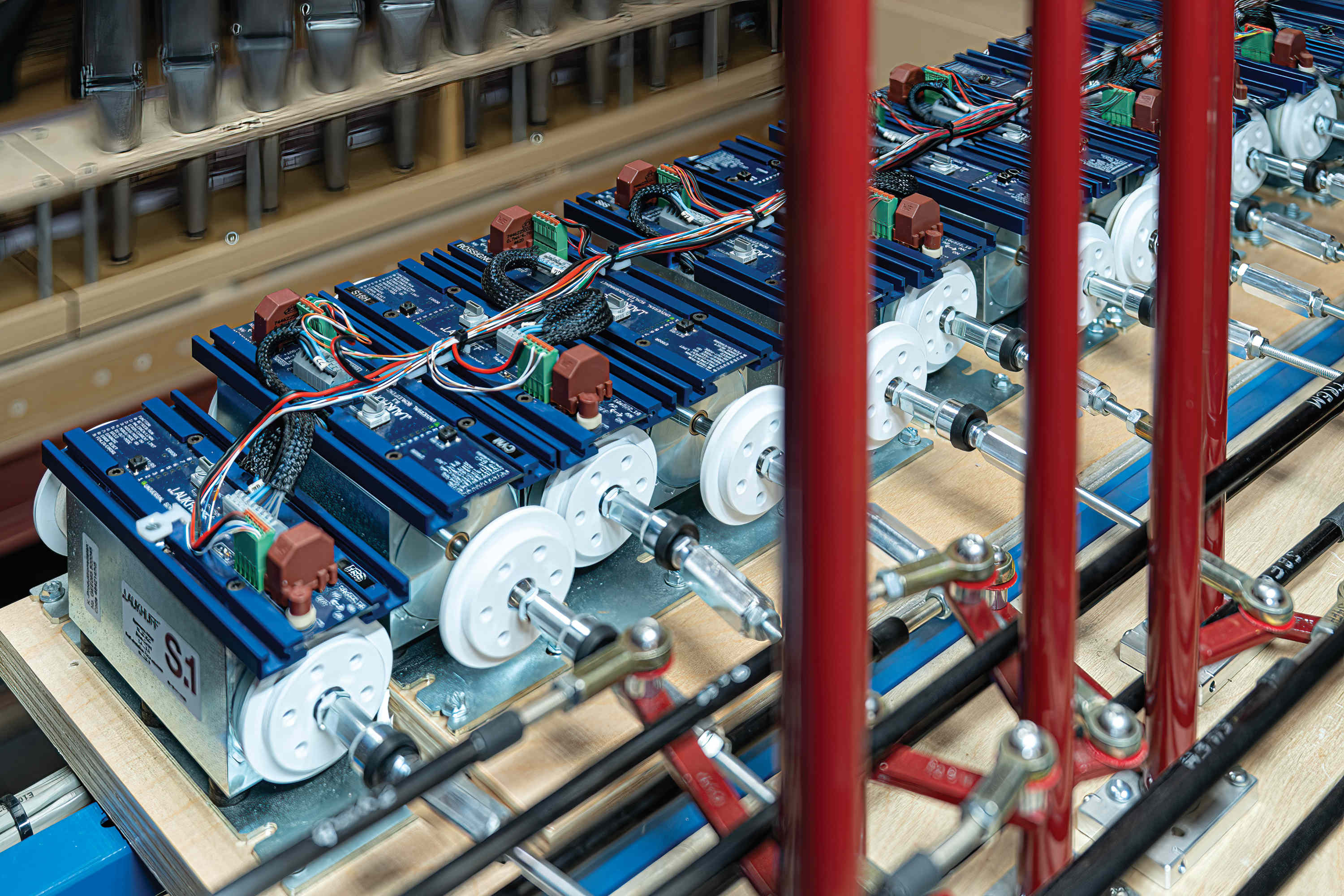
Opus 158 is a dual mechanical/electric- stop-action instrument augmented by a 1,000-level SSOS combination-action system. Levels are divided into public and private libraries available to students, faculty, and visiting recitalists.
Discussion about the practice organ mostly centered on how to most efficiently fit the seven-stop instrument, fully enclosed in an expression box, in a small-scale asymmetrical space with limited ceiling height. Fortunately, the HKBU team found a way to reorganize the “attic” volume, allowing the expression box to extend, without interference, above the lowered visible ceiling. This welcome development in turn reduced the need for mitering or Haskelling the two open 8′ basses.
Ornamentation for both instruments was conceived by Hong Kong native Eric Lau. Educated at the Parsons New School for Design in New York City, Lau has spent his entire career as a professional designer and photographer in the United States. His novel pipe shades, which add a visual stylishness to both organ facades, were machined at the Fisk workshop. Lau also devised a geometric pattern based on the HKBU logo; it has been engraved onto the three panels surrounding the performance organ’s music desk as well as onto the tall black panels that flank its oak casework.
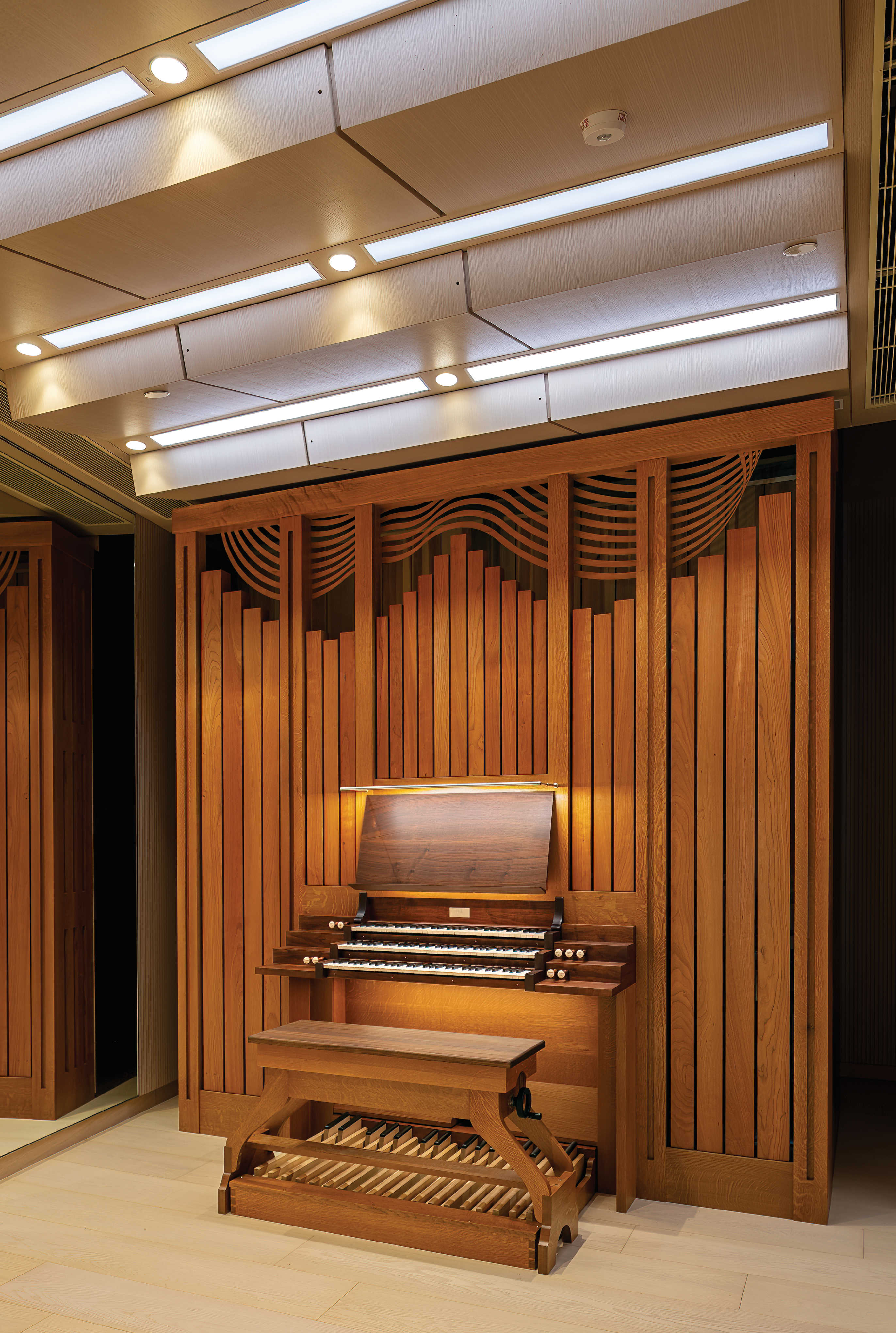
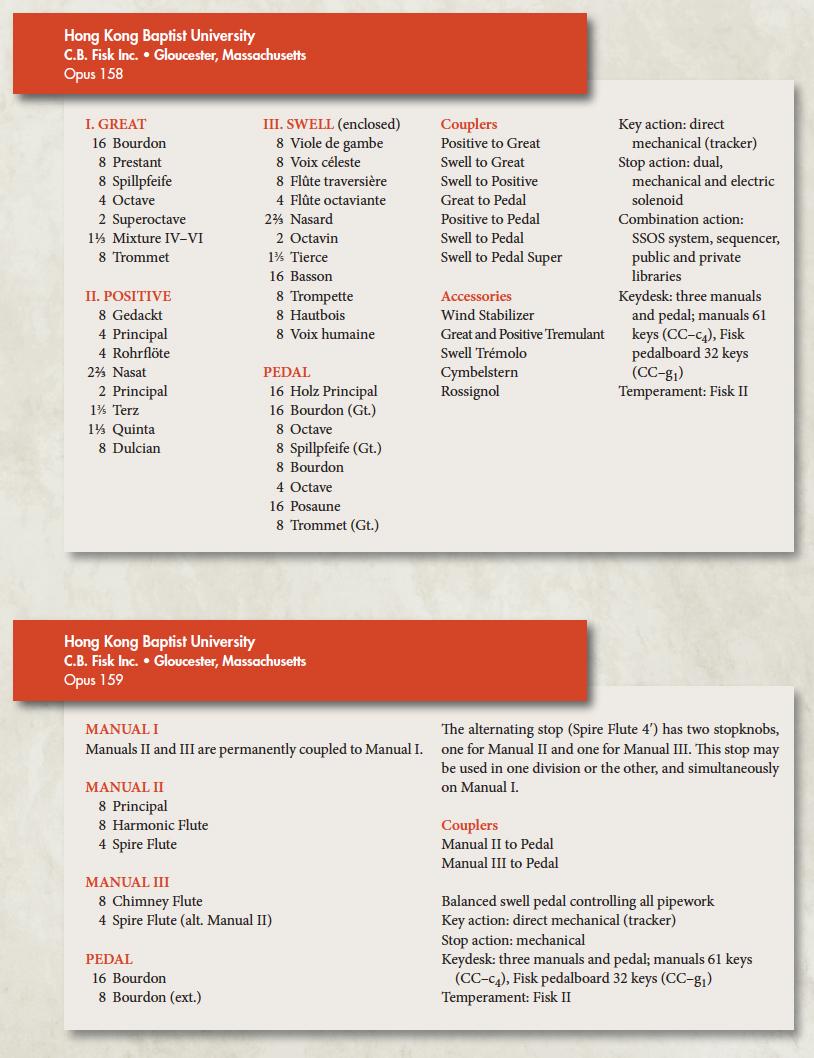
Opus 159 is a companion practice organ of five voices. All stops are enclosed in a single expression box. The room was designed with height to accommodate two full-length 8’ open basses with minimal Haskelling.
As ultimately designed, Opus 158 is a three-manual, 33-stop instrument whose tonal profile is at once historically informed and broadly eclectic. Performers have at their disposal authentic sounds from 18th-century Germany as well as 18th- and 19th-century France. These tonal resources are accessed by way of a precise and reliable carbon fiber–based key action. The stop action is a dual mechanical and electric solenoid system; a combination action, including sequencer, was provided by SSOS. The Great division is placed at impost level, with the side-to-side Swell just behind. The Positive, by virtue of its low placement immediately to the right of the console, excels in many roles, including as a basso continuo. The Pedal division, running front to back, stands at floor level to the left of the console. The organ also features a wind-driven Cymbelstern and a Rossignol. Manual wind pressure is 2¼″; Pedal pressure is 3″. The temperament is Fisk II.
Opus 159 is configured in such a way that Manual I serves simply as a coupling manual. Any stop drawn on Manual II or Manual III appears automatically on Manual I, offering the player a surprising assortment of registrational options on an organ with limited resources. The stoplist comprises two full-length 8′ registers (Principal, Harmonic Flute), an 8′ Chimney Flute, a 4′ Spire Flute (alternating between Manuals II and III), and a Pedal Bourdon 16′/8′ unit.
Installation of both organs commenced in April 2025, and finish voicing of pipework, led by the tonal director, is ongoing. The inaugural recitals will take place in late October and will feature Ken Cowan, professor of organ at Rice University’s Shepherd School of Music.
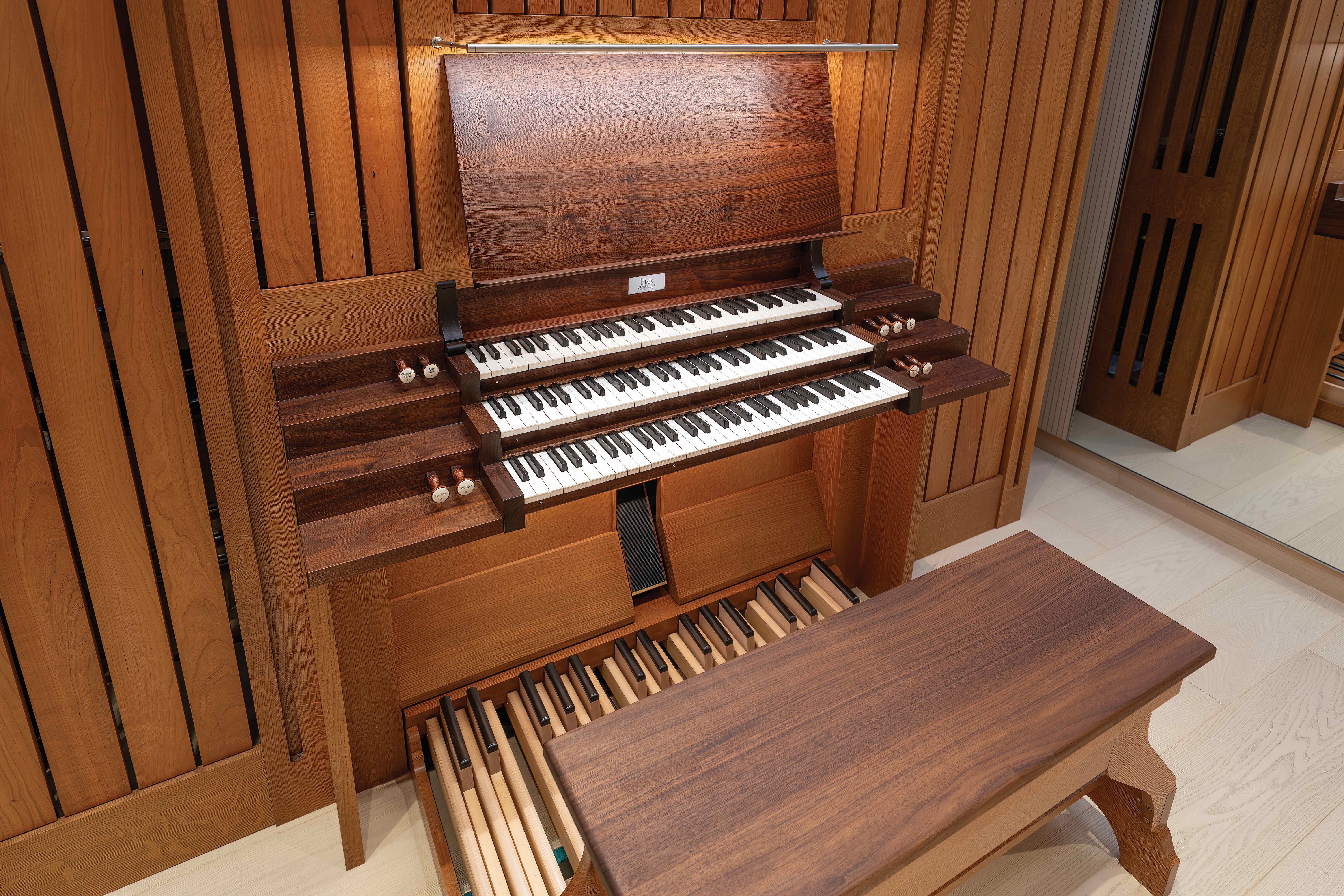
The three-manual console and drawknob layout were designed to provide students with a seamless transition to the recital organ.
HKBU’s procurement of these two Fisk organs represents more than an enhancement of the university’s musical resources: it signifies a broader commitment to cultivating a vibrant organ culture in Hong Kong. As these organs begin to make their presence felt within the Jockey Club Campus of Creativity, not only will they elevate the standard of musical education at HKBU, but they will also enrich the cultural fabric of Hong Kong at large, inspiring future generations of organists and music enthusiasts. For this, we are genuinely grateful to all who contributed to making these organs a reality.
David C. Pike
Photography: Kris Yee Koon Sing
@Academy of Music HKBU