Christ Episcopal Church
Glendale, Ohio
Casavant Frères
Saint-Hyacinthe, Quebec
From the Director of Music Ministries and Organist
Founded in 1865, just north of Cincinnati, Christ Church Glendale is a historic congregation with a lively music program. The original building, completed in 1869, is called the Historic Church; it hosts two Sunday morning services each week. CCG also has two chapels, the larger of which hosts a third Sunday morning service and is home to C.B. Fisk Opus 146 (II/26).
From 1911, the Historic Church was home to a Roosevelt/Möller organ. Originally built by Roosevelt for New York City’s Chickering Hall, the instrument was removed prior to the hall’s closing. Much of the original pipework was installed at CCG by Möller, alongside new windchests, a new console, and some additional pipework. The organ had its last rebuild in 1940, and after this, few mechanical changes were made. Over the next 80 years, however, the instrument was “updated” as needed or wanted. This included many unfortunate tonal changes that dramatically altered the original sound of the organ. Most of the reeds were replaced, with a preference for “bright and cutting” over “dark and full.” A 4′ Violina was removed from the Swell and replaced with a nearly unusable high-pitched mixture. The saddest change of all happened in 1970, when a massive Open Wood (15″ x 16.5″ at low C) was replaced with a secondhand Bassoon of limited utility. This left the organ lacking any substantial foundation tone in the Pedal.
When I was hired in late 2020, I began to look closely into the instrument’s condition and hired a local organ company to inspect it thoroughly. Their report, unsurprisingly, made it clear that significant work was needed. Over the next year, I began consulting with a handful of prominent organbuilders, seeking advice and proposals for what they might do with our instrument. All of them suggested full replacement, while saving some of the best pipes for reuse. An organ committee was formed, and we began to consider all of the factors involved. After many meetings and presentations, it became clear that Casavant Frères would be the best choice to complete the project. I knew of their fine work firsthand—and that the collegial process of honing the instrument’s stoplist and other details would be a pleasure. The committee was impressed by the company’s business and logistical background, as well as the beautiful facade they had designed. A contract was signed in December 2022.
It is fair to say that, as of this writing, the organ is not yet finished. Some minor unforeseen delays caused completion to be pushed back from December 2024 to Easter 2025. Despite this, we kept the June TAO cover feature to build excitement in anticipation of the mid-June conference of the Association of Anglican Musicians in Cincinnati, when our organ will be featured in the Gerre Hancock Intern Recital. The instrument is physically installed, and at present tonal finishing is about 50 percent complete. Having heard the organ in the factory before it was shipped, I’m beyond excited to hear it being carefully refined in our room.
Articles about new organs often include lengthy (and sometimes unrealistic) lists of what the instrument should be able to do. In contrast, my approach to designing this organ was to envision something that would effectively “play church”—an instrument that, first and foremost, would help people glorify God in worship. That includes supporting congregational singing and accompanying choirs of adults and children. It also means bringing to life the words of the Gospels read each Sunday and helping people in moments of quiet meditation. At times it must celebrate, and at others, soothe. As for tonal character, I was seeking an English/19th-century American sound, and the designers at Casavant were willing to step outside of their usual practice to make this happen. That said, I also wanted to honor Casavant’s history and expertise, so I looked for ways to include unmistakably French sounds as well.
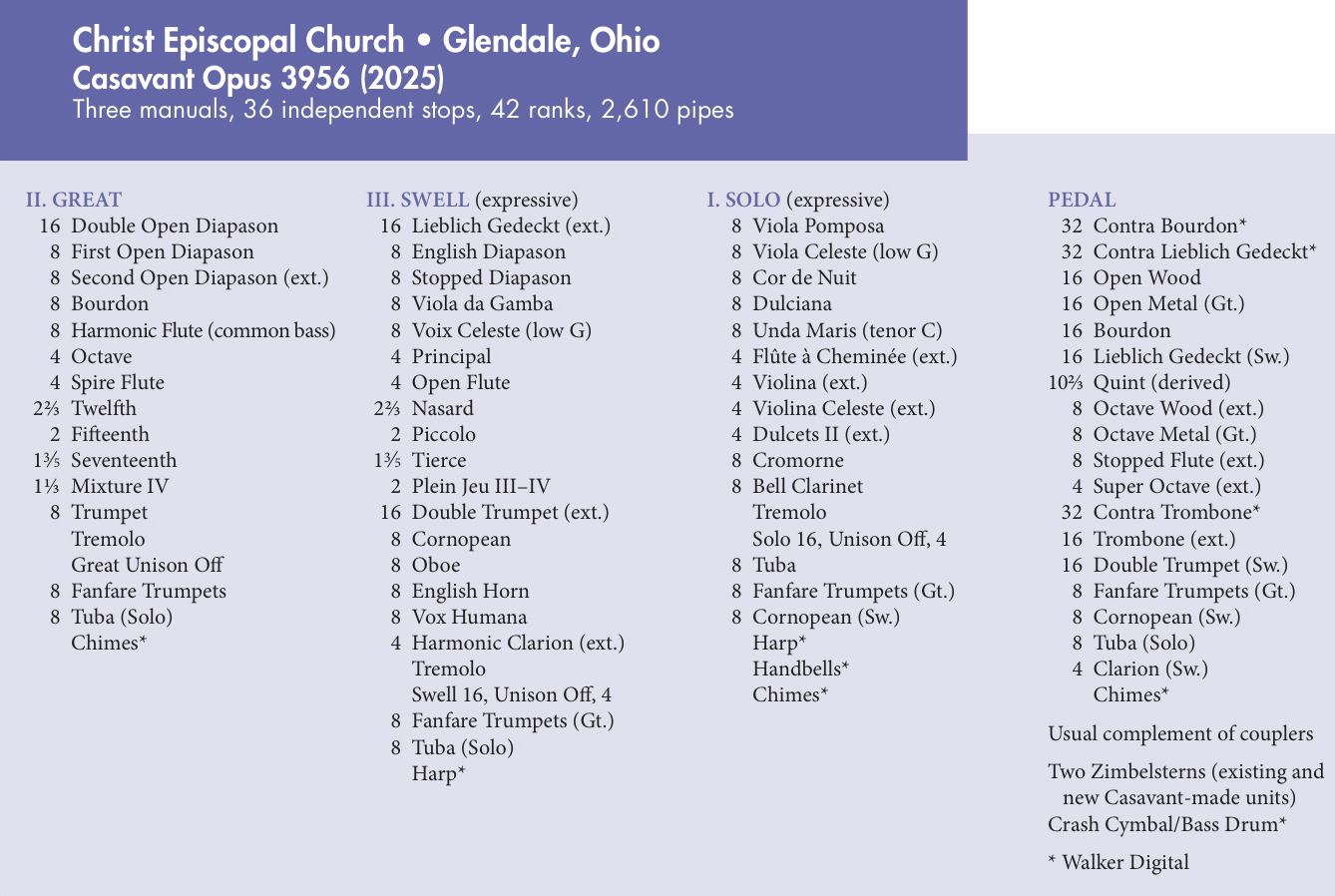
The Great division has two 8′ Diapasons, both new. As is customary, the Second Diapason is meant for the diapason chorus, while the First Diapason fills out the sound of the Great with warmth and vigor. Two 8′ flutes, one harmonic and one stopped, offer variety. Independent mutations at 2 ⅔′ and 1 3⁄5′ provide options for upperwork other than the Mixture and also supply a diapason-scaled Cornet. An English-style Trumpet with tapered shallots caps the Great. One of two existing solo reeds, the 8′ Fanfare Trumpets, was reused and revoiced. The stop speaks clearly from the upper level on 6″ of wind.
Most of the pipes reused from the previous instrument are found in the Swell division. The 16′ Lieblich Gedeckt was restored and improved, and the old Great Second Diapason was moved to become the Swell 8′ English Diapason. There is no “Geigen” or “Horn” here; the stop is buttery and lush and supports the rest of the ensemble rather than overwhelming it. The rest of the diapason chorus is meant to be secondary to the Great chorus. A flute-scaled Cornet is found here, also with independent mutations. There are four independent reeds in the Swell—a deliberate decision. The Oboe and English Horn, two beautiful solo voices of different character, can be used individually or together for choral accompanying. The French-style Vox Humana was built with Franck in mind. Lastly, the 8′ Cornopean crowns the ensemble with a dark and full-bodied tone. This stop was part of the previous organ; however, many years ago it had been removed, packed in a box, and placed on top of the Swell enclosure (having been replaced with a brighter, more cutting Trumpet). I’m glad it was saved and am overjoyed to finally hear it back where it belongs! It is extended down to 16′ as the Double Trumpet and up to 4′ as the Clarion. This voice gives the Swell a full reed chorus and doubles as a second Pedal reed.
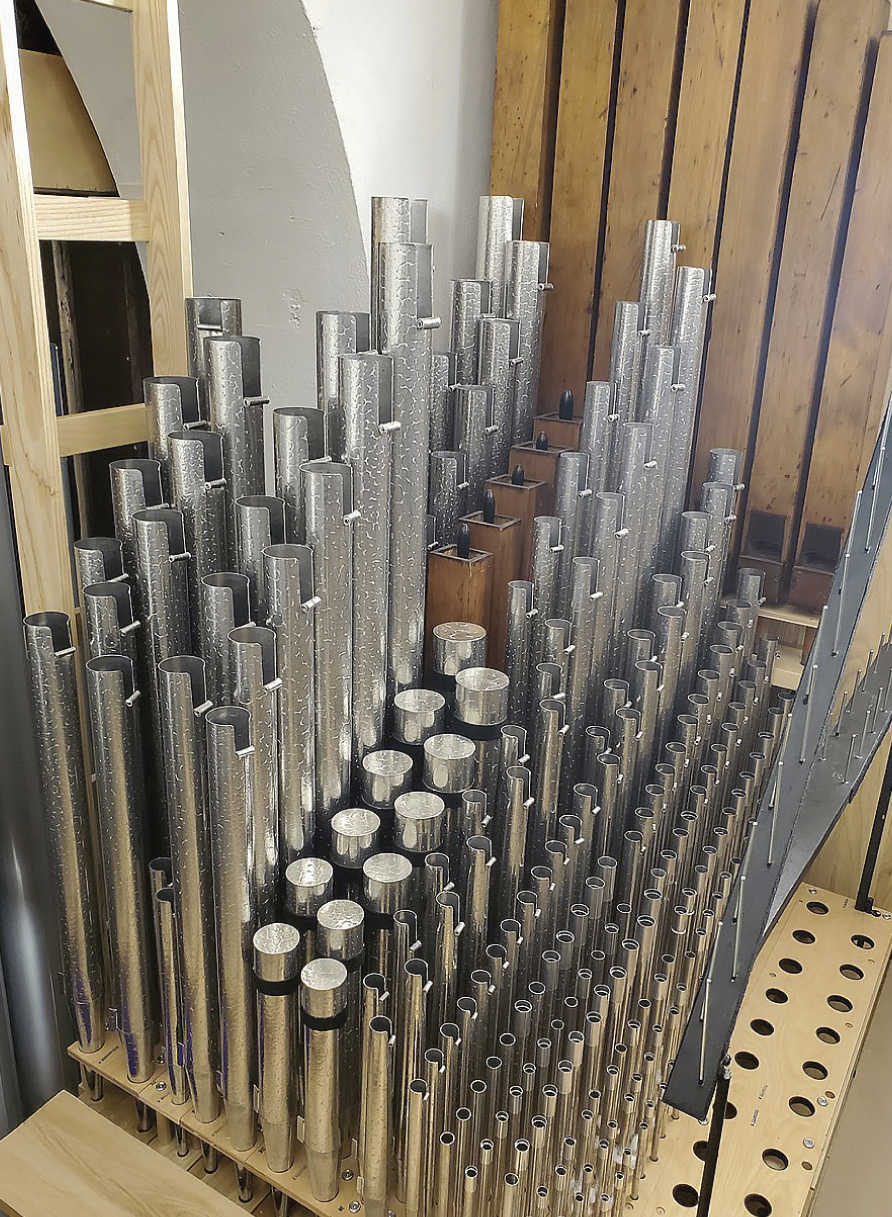
Great pipework installed and awaiting voicing. The Trumpet will be installed last.
When it came to a third manual division, I was looking for ways to include more color and variety, rather than to provide an additional principal or flute chorus. For that reason, I opted for the flexibility of a Solo division rather than a more traditional Choir. The Solo has two sets of strings: a Viola Pomposa and Celeste (new) and a Dulciana and Celeste (old). Both pairs were extended to 4′ range and given their own 4′ drawknobs for those times on Sunday when you need extra strings quickly; this also allows the sets to be used at different levels independently. That said, with the strings on at 8′ and 4′ pitch, one can employ the sub and supercouplers and envelop the church with string tone at 16′, 8′, 4′, and 2′. An 8′/4′ unit flute was included to help with accompanying. The Solo has two chorus reeds: an 8′ Bell Clarinet (old) and a French-style 8′ Cromorne (new). The 8′ Tuba is the organ’s other solo reed; it speaks majestically on 13″ of wind. One might consider that to be an overly powerful Tuba for a room that seats about 250, but the layout required it to be placed at the back of the Solo on the lower level. While this is not optimal placement for a Tuba, it allows it to be enclosed and therefore more flexible.
The Pedal division was designed with careful attention to providing plentiful foundation tone. For that reason, I wanted both Open Wood and Open Metal stops at 16′ pitch. In the early stages of planning, this was something I found that only Casavant could do without compromise. The 16′ Bourdon is of large scale and provides even more heft. As is customary, most of the Pedal upperwork comes from extensions or manual divisions. The 16′ Trombone was built with leathered shallots, making it commanding but not impolite. There are three 32′ digital voices, all provided by Walker: an extension of the Trombone and two flute stops, big and small.
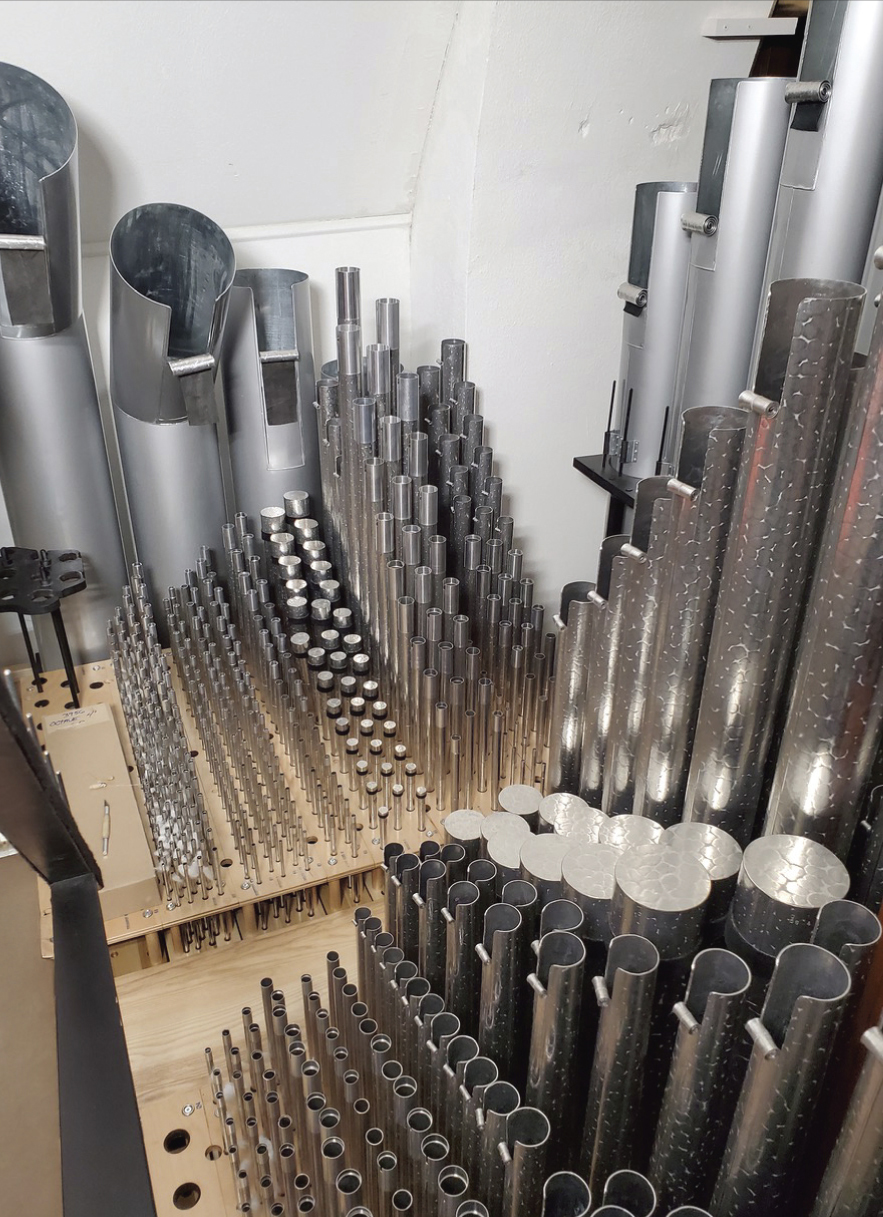
Another view of the Great division. The bottom few pipes of the 16′ Open Metal can be seen in the background.
Lastly, a handful of percussion stops provide extra color when required. All are from Walker Digital, save the two (!) Zimbelsterns. In addition to the “standard” Chimes and Harp, I opted to include a Handbell stop. And for grand occasions, there is a toe stud that activates a bass drum/crash cymbal hit.
As the organ nears completion, I am immensely thankful to Simon Couture and his colleagues at Casavant Frères. This collaborative process has truly been enjoyable, from start to finish, and I know that this organ will “play church” for generations to come.
Tyler W. Robertson
Director of Music Ministries and Organist
Christ Church Glendale
From the Builder
At the time of our initial visit to Christ Church Glendale, in March 2022, Tyler Robertson, director of music ministries and organist, voiced his clear vision that he wanted the new organ to “play church” effectively. Tyler also expressed a keen interest in seeing retained in the new organ the best pipework from the existing instrument, especially the heritage stops from the original Roosevelt, Opus 25.
Throughout the process, we worked closely with Tyler to design the most complete and uniquely colorful three-manual organ possible for installation in the existing chamber, while making sure it would be easy to tune and maintain in the future. This ongoing creative dialogue has been key to the success of the project.
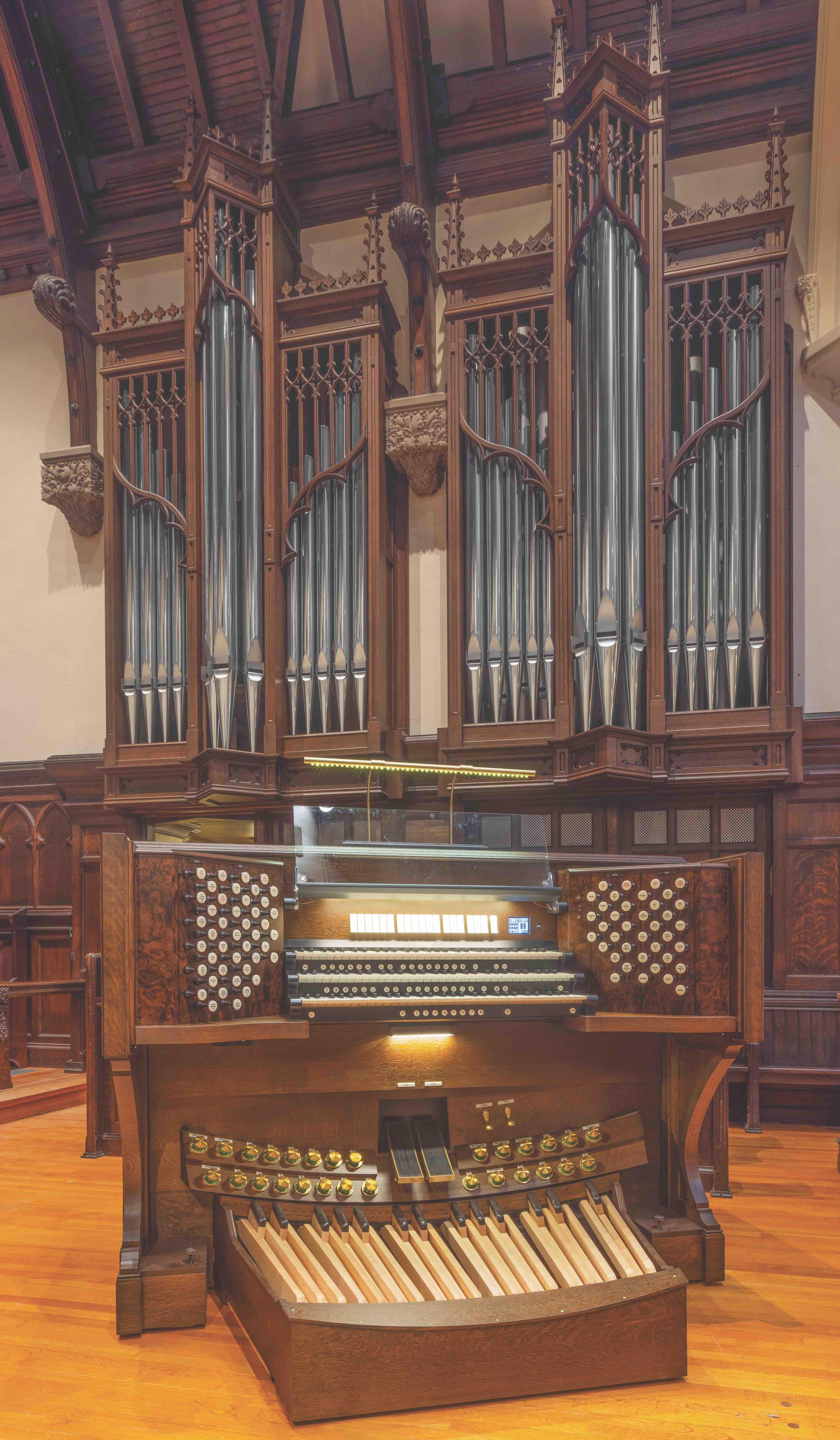
The layout of the new organ is quite effective and disciplined. The Great, Swell, and Pedal divisions are installed at the upper level, for optimal projection into the room. The expressive Solo division, which is installed at the lower level, has been provided with horizontal expression louvers that open upward. This—along with new openings in the existing wainscoting—helps the more orchestral sound of the division to get out of the chamber. The original tone opening toward the transept, which had been blocked in the past, has been reinstated to optimize the tonal egress of the Pedal division.
When visiting a potential new project for the first time, we always ask ourselves, “Is there anything worth keeping?” In this case, as Roosevelt remains an almost mythical name in our profession, we agreed wholeheartedly to reuse the heritage stops. Originally installed in Chickering Hall in New York City in 1876, the organ was moved to Thiel College in Greenville, Pennsylvania, in 1902. Möller relocated the organ to Christ Church Glendale in 1911 and rebuilt it. Fortunately, the existing pipework was in decent condition and restorable. Reusing these Roosevelt stops offered an intriguing possibility to create a sound that would differ somewhat from our usual practice.
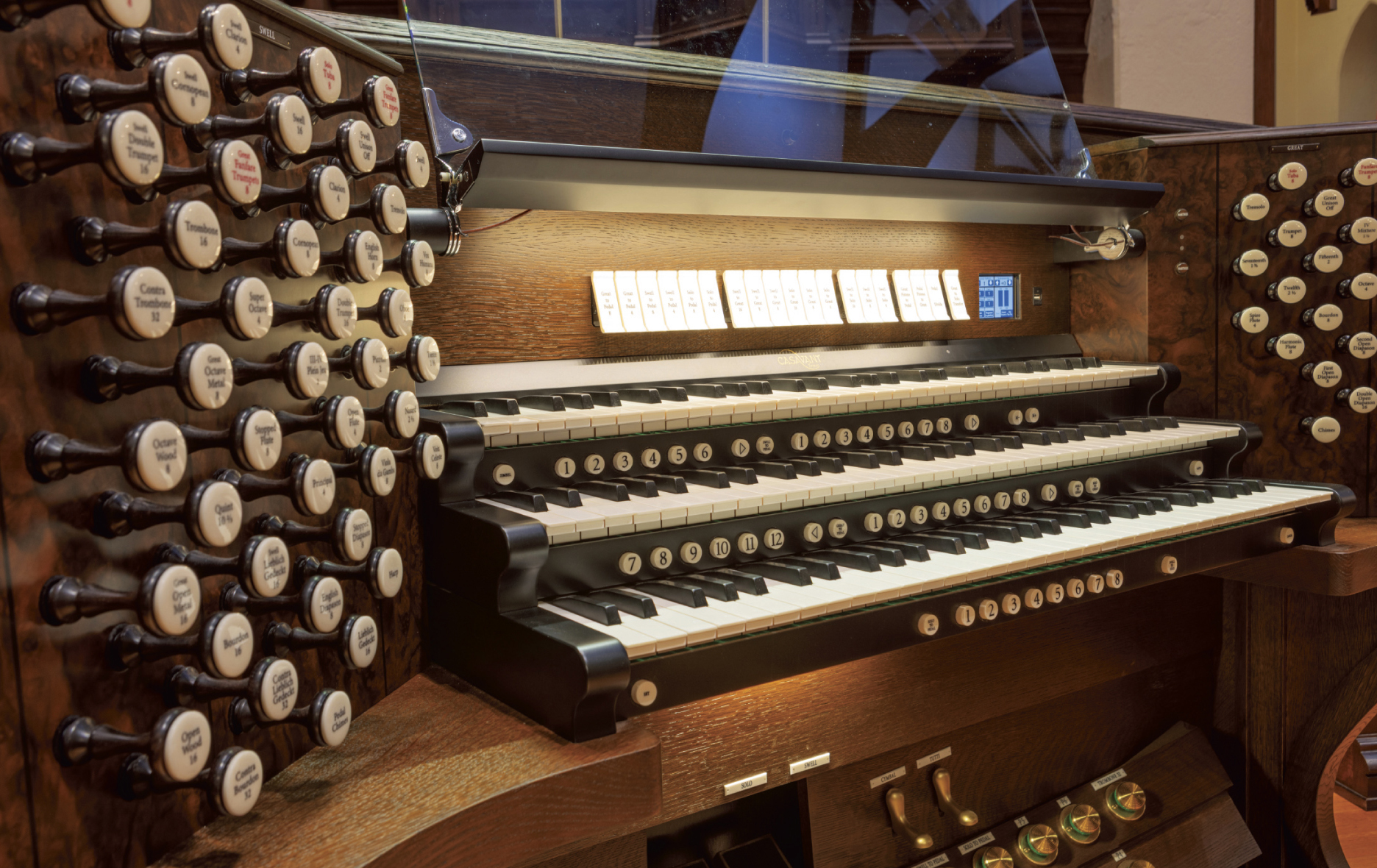
Finally, we were asked to provide new organ facades to conceal both tone openings in the chancel. The new neo-Gothic facades of stained white oak, designed and built by Casavant’s craftspeople, complement this beautiful, historic church. Similarly, the console was designed with carved elements to match the elegance of the facades.
We wish to express our most sincere thanks to all the people we have worked with in the last four years, especially to Tyler Robertson for his genuine passion, his outstanding guidance, and his enthusiastic collaboration through every step of this exciting project. We also extend our gratitude to the members of the Building and Grounds Committee, who oversaw the extensive work to prepare the chamber and the blower room for the installation. May this new organ “play church” for many generations at Christ Church Glendale.
Simon Couture, Alain Goneau, and Dany Wiseman
Casavant Frères