JANUARY 2025
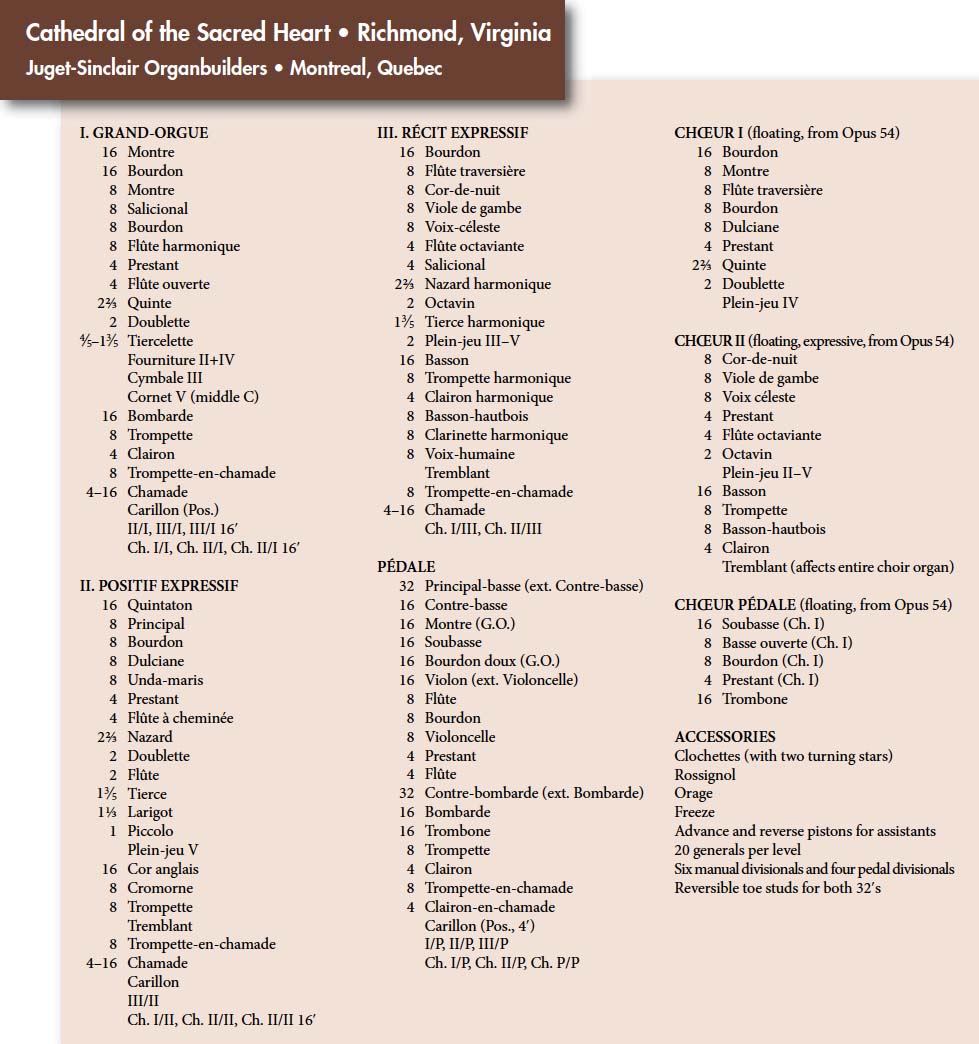
Cathedral of the Sacred Heart
Richmond, Virginia
Juget-Sinclair Organbuilders
Montreal, Quebec
New Organs for an Old Cathedral
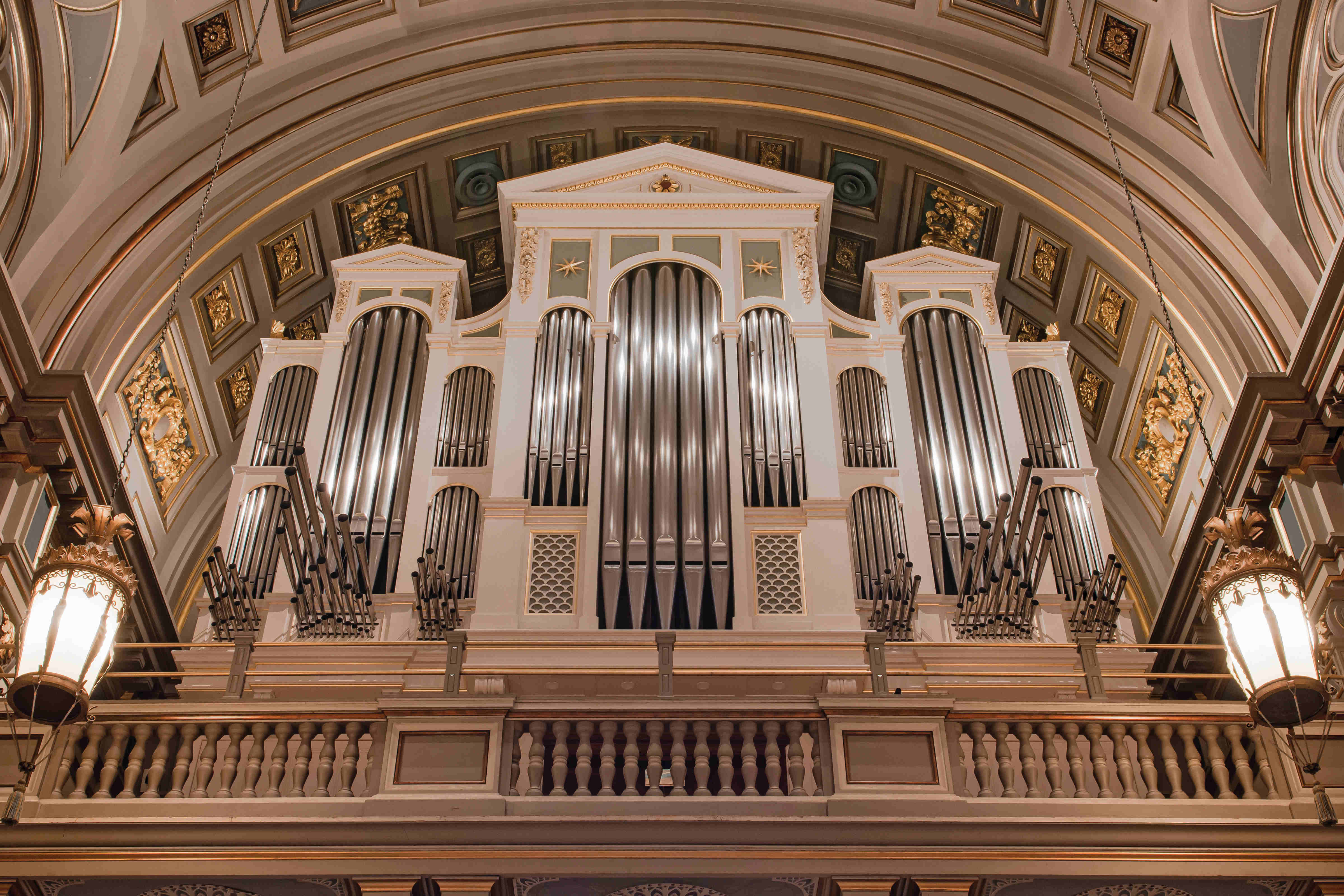
Opus 55: Case view from the back of the nave (photo: Robin Côté)
For more than a century, the organ at the Cathedral of the Sacred Heart in Richmond, Virginia, had, under the skilled hands of organists, brought forth music to lead generations of worshipers and inspire visitors. By the mid-2010s, however, it was clear that the instrument had given all it could give.
“Parts of it just didn’t work,” said Carey Bliley, a parishioner who had served as substitute organist and became chair of the cathedral’s organ committee. “The organ technician who was maintaining it would get things working temporarily, but there were bigger issues.”
The cathedral, which is on the National Register of Historic Places and is a Virginia Historic Landmark, was consecrated on November 29, 1906, Thanksgiving Day. The pipe organ, which occupied the upper gallery at the rear of the church, had been installed a few months prior to the dedication.
In 2015, multiple restoration consultants indicated that the organ was past saving. Thus began a journey that led to the building and delivery of three Juget-Sinclair instruments—a choir organ, continuo organ, and gallery organ—the last of which was blessed and dedicated in September 2024.
“This is a once-in-many-generations type of project,” Bliley said. “We needed to do it right.”
Setting the Wheels in Motion
Bliley, who is president and CEO of one of Richmond’s largest funeral homes, knew that the process would be nearly as important as the instrument itself. “We had meetings to get feedback and educate everyone,” he said. “We took people inside to see the duct tape holding things together.”
The effort to replace the pipe organ gained immediate support from the Cathedral of the Sacred Heart Foundation, which was formed in 2013 specifically to address preservation issues within the cathedral. In 2016 the foundation determined that the organ was an integral part of the cathedral and required immediate attention.
The committee had members with a variety of perspectives and opinions who came together for a common mission: “We recognized that the organ should support the church’s liturgy, be fiscally responsible, and last for years,” Bliley said.
For expertise, the committee sought out Paul Thornock, who serves as director of music and organist at the Cathedral Basilica of St. John the Baptist in Savannah, Georgia, and regularly consults with churches on similar projects. His first step: taking the committee to listen to other organs.
“The committee felt like organs in the German style had been done in American cathedrals,” Thornock said. “They thought it was time to do something in the French direction.”
The committee also decided that the cathedral should have three organs: a choir organ at the altar, a smaller continuo organ that could easily move within the sanctuary, and the primary gallery organ. “We thought, if we’re going to do a project, let’s focus first on what the needs are,” Bliley said. “We compiled a wish list and requested proposals from builders.”
A Plan Comes to Life
The committee traveled many miles to play and listen to instruments from organbuilders under consideration. They went to Dallas and Nebraska, and then to Europe—where they visited four countries in four days. Both undertakings were self-funded.
Just after the committee’s work began, the cathedral welcomed a new director of music and liturgy, Daniel Sáñez, who traveled with the committee to hear instruments crafted by different builders.
Sáñez recalls hearing the Juget-Sinclair organ at Our Lady of Guadalupe Seminary in Denton, Nebraska. “I was surprised by how the instrument felt, the mechanical action—it was so light, so facile, so easy to play,” he said. “That made a bigger impression even than how it sounded. It was like it was alive under your hands.”
Ultimately, the committee accepted a plan from Juget-Sinclair in Montreal. The continuo and choir organs were delivered to the cathedral in 2022, immediately making a great impression. “They’ve got such beautifully crafted tones,” Sáñez said. “People really enjoyed singing with them.”
Then, when Sáñez sat to listen to the gallery organ after its final voicing in summer 2024, he was astounded. “What amazes me is that all the various national styles of organbuilding are incorporated and beautifully synthesized—from Spain to Italy to France to Germany—and also sounds of the Renaissance, Baroque, Romantic, modern styles,” he said. “The organ does everything in a historically accurate way.”
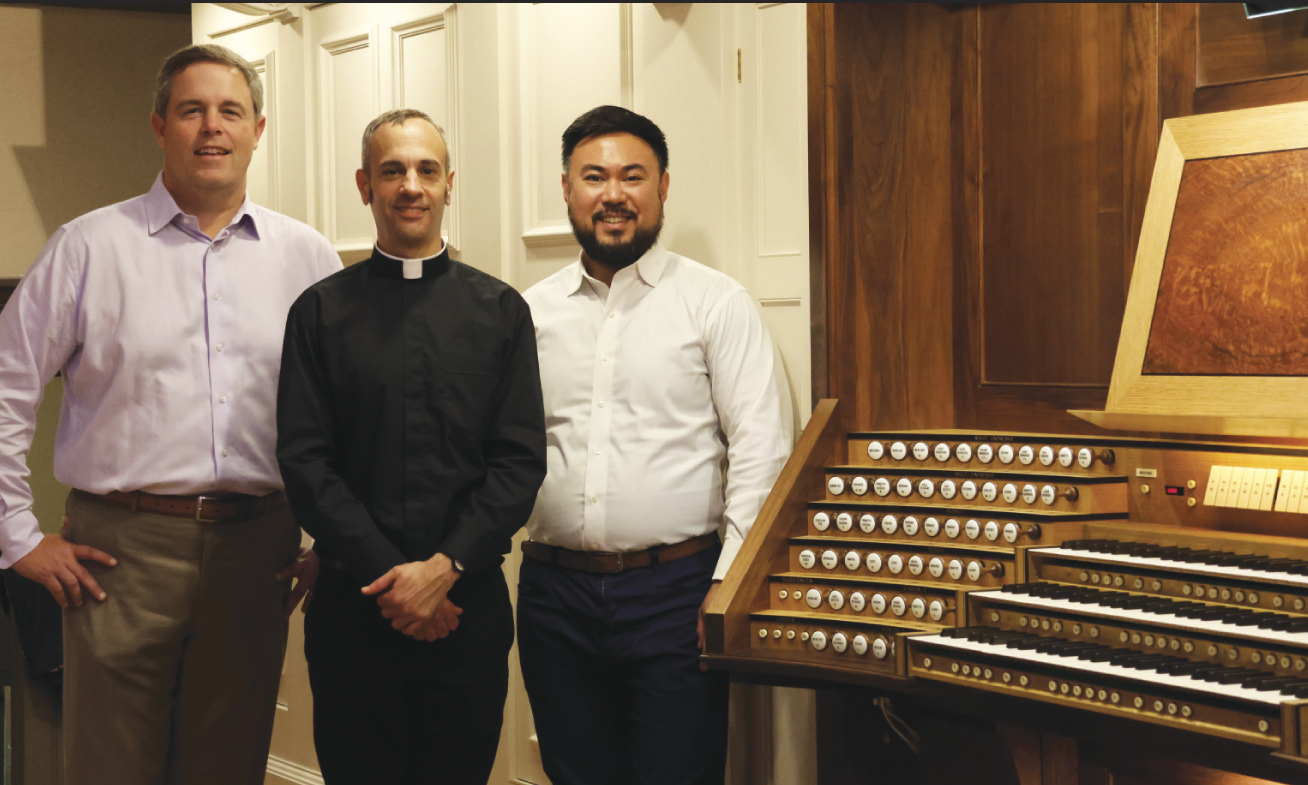
Admiring the console of the new gallery organ are Carey Bliley, chair of the pipe organ committee; Fr. Anthony E. Marques, rector of the Cathedral of the Sacred Heart; and Daniel Sáñez, the cathedral’s director of music and liturgy. (photo: Catholic Diocese of Richmond)
Sharing the Good News
Music within a church is more than just accompaniment to worship.
“An organ evokes God’s majesty and greatness, and also his gentleness,” said Fr. Anthony E. Marques, the cathedral’s rector. “Within the church, the instrument also represents human ingenuity, artistic sensibilities, and a sense of wonder and beauty. We’re using all of those things to worship God. Our hope is that the parish would have an even deeper appreciation for beautiful music and how our lives, really, are supposed to be as beautiful.”
The decision to incorporate three organs to replace the original instrument was based on the cathedral’s strong commitment to providing inspirational music for all types of liturgical services as well as for community outreach. “We want to lift the spirits of those who come in off the street,” Bliley said.
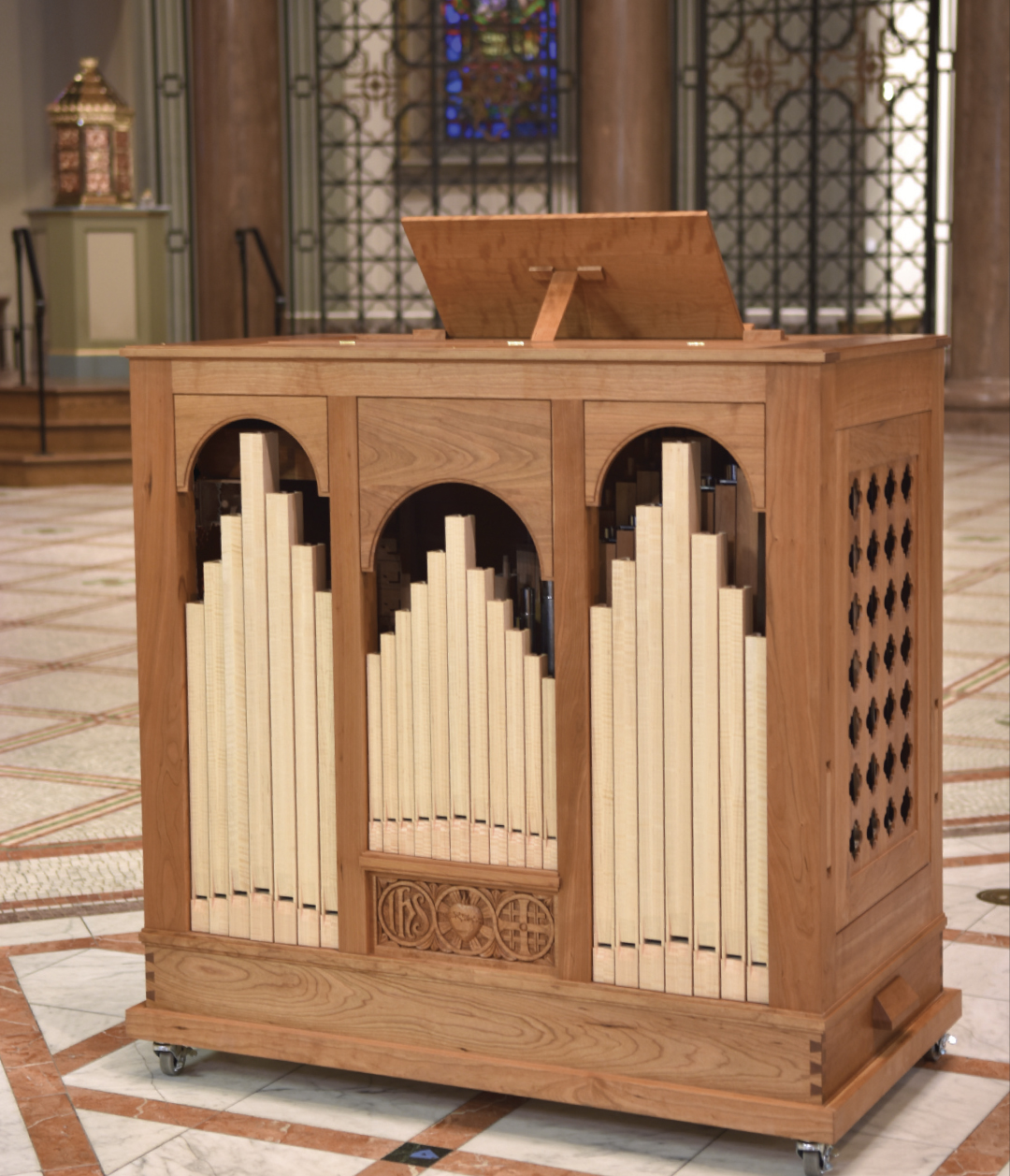
Opus 53: Juget-Sinclair continuo organ (photo: Robin Côté)
The cathedral’s concert series, Music for a Cathedral Space, made possible by the E. Rhodes and Leona B. Carpenter Foundation, draws thousands to the cathedral every year. Guest artists invited to play the new gallery organ have included Olivier Latry, titular organist at the Cathedral of Notre-Dame in Paris, and Jean-Baptiste Robin, organist of the Chapel Royal at Versailles. “We’re proud and grateful that the Cathedral Foundation wanted to pass along these three new pipe organs as a gift to the community,” Sáñez said.
Bliley added: “The cathedral is committed to being embedded in the life of our Richmond community. We hope these instruments will help us fulfill our mission to share God’s love widely.”
Paula Peters Chambers
Opus 55: An Organ Worth of a Cathedral
The year 2024 was an important one for Juget-Sinclair: our 30th anniversary coincides with the completion of our largest project to date. The acceptance of our proposal to build three organs (continuo, choir, and gallery) for the Cathedral of the Sacred Heart in Richmond, Virginia, was certainly stimulating for our team, but it also laid the foundations of a fruitful relationship with the organ project committee.
Obviously, this relationship goes beyond just business: after having spent more than five months in Richmond, we traveled all over Virginia, made new connections, and deepened existing ones. It goes without saying that this has inspired us and contributed to the unique character of these three organs.
The choir organ, Opus 54, is a 21-stop mechanical-action instrument discreetly located in the ambulatory. It accompanies smaller liturgies but also held down the fort during the replacement of the gallery organ. Opus 54 is small but mighty, and thanks to the apse, its sound is projected efficiently and into all corners of the cathedral. This organ was built with dual action: it can also be played electrically from the gallery console (though the gallery organ cannot be played from downstairs). The expression of the choir organ is mechanical when played from downstairs, but a linear servo motor smoothly and silently operates the expression when the organ is played from upstairs.
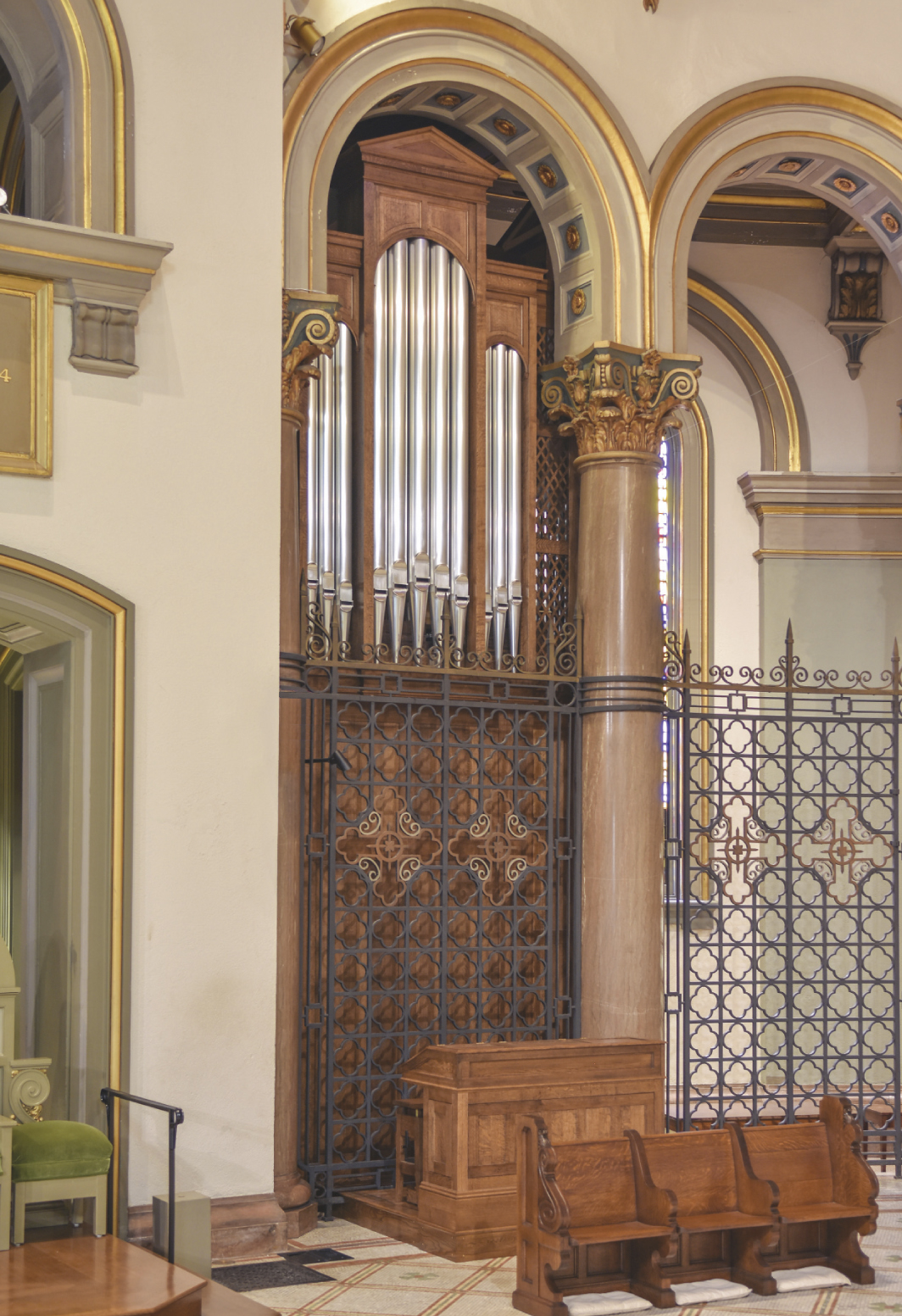
Opus 54: Juget-Sinclair choir organ (photo: Robin Côté)
Process
For our part, it all starts with measuring the space, creating a vision, and putting this into a formal proposal. What we felt would suit the cathedral seemed to come as such a natural fit that the completed gallery organ has hardly strayed from the initial proposal.
Our approach to organbuilding is guided by our desire to build as much as possible ourselves. This is as philosophical as it is practical. We can realize the organ exactly as we imagine it, right down to the font of the pistons, and we can approach challenging designs with confidence. Some subcontracting was required, however. The blower, combination system, and facade pipes (since we cannot make 16′ metal pipes) were all purchased from trusted suppliers. However, we wished to collaborate with colleagues of ours near Poitiers, Atelier les Voix Humaines, who built the 16′, 8′, and 4′ Trumpets of the Grand-Orgue and Pédale. They do excellent work, and we are so pleased to be able to include them in our organ.
To further refine our musical vision for the gallery organ, Robin Côté and Alex Ross spent a week in France to find inspiration and ideas in such masterpieces as Sainte-Croix in Bordeaux, Aire-sur-l’Adour, Saint-Sever, and Toulouse’s La Dalbade, La Daurade, and Saint-Sernin. These organs and others informed our approach to the overall voicing scheme, but they also provided some fun and interesting ideas, such as a triple-length Harmonic Clarinet, which we found at Saint-Sever and were happy to try ourselves in Richmond.
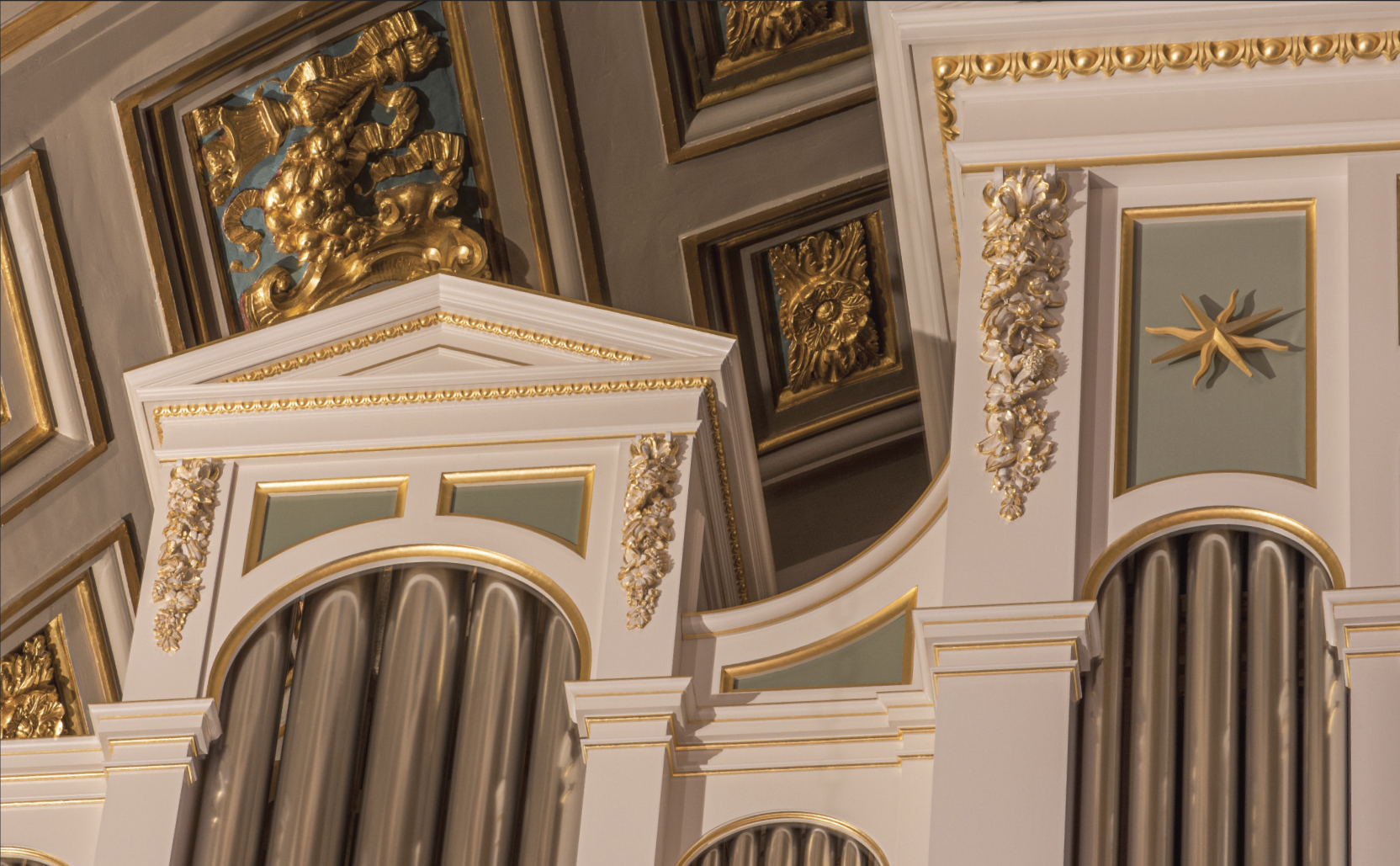
Floral garlands and upper-case details (photo: Robin Côté)
All organs we visited in France are situated in sumptuous acoustics. Creating a French-inspired organ in a dry room can be like trying to make steak frites without the steak! Fortunately, the cathedral in Richmond boasts 5.5 seconds of reverberation and good frequency response. Though the choir organ may speak evenly into the room, the gallery organ (being close to the vault) reacts a little differently.
Tests we made several years ago revealed that where we have ultimately chosen to situate the Positif projects clarity and articulation into the nave, while the vault helps the Récit to soar right to the other end of the cathedral; the Grand-Orgue and Pédale have great breadth—a perfect fit for our concept!
Result
Visually, we sought to create an architectural unity between the cathedral and the organ by respecting the Neorenaissance style of the space. To better integrate the instrument into the community, the Sacred Heart of Jesus is displayed on the tympanum of the grand pediment to represent the patronage of the cathedral, and the favorite flowers of the principal donors are sculpted into the garlands.
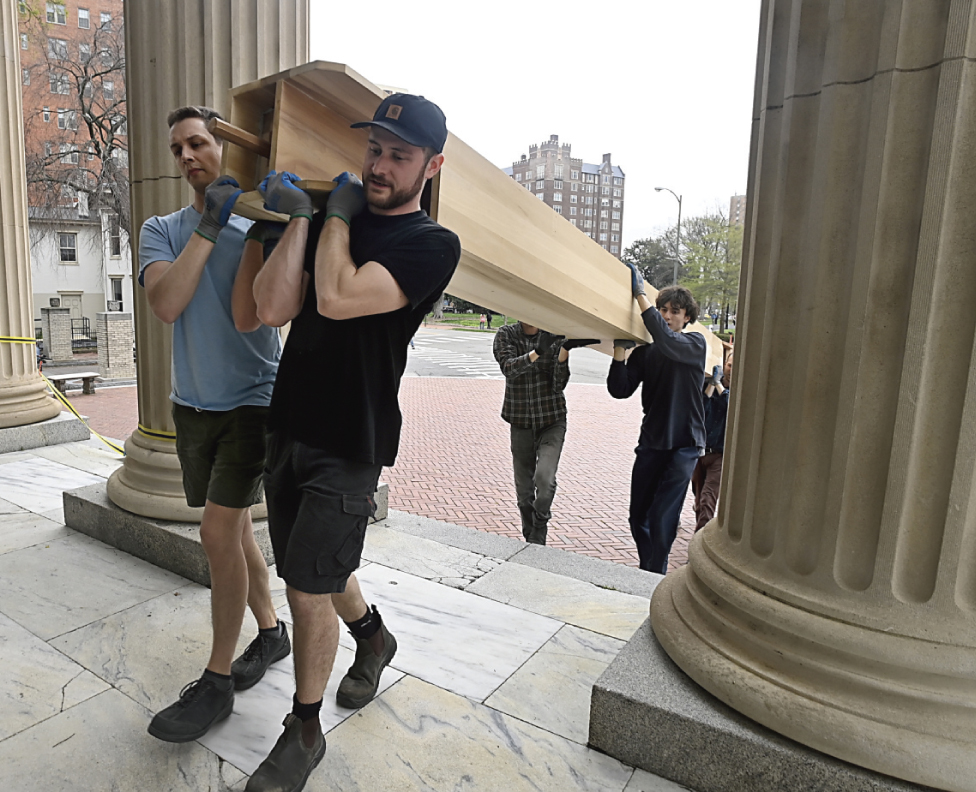
The Juget-Sinclair team carries the low C of the 32′ Principal-Basse into the cathedral. (photo: Alexa Welch Edlund)
As the surface area available in the choir loft is limited, the windchest placement is dictated by the case. Behind the central tower, we find the Récit and Positif boxes stacked one atop the other. On either side of the center are situated the Grand-Orgue and Pédale windchests. On the floor level, there are six cuneiform bellows, console action, and electric pedal windchests for the 16′ and 8′ flutes, as well as the 32′s. The blower and primary are located in the original blower room, but our wind system draws directly from the loft.
Knowing the detrimental effects of stratification, we recommended to the committee that a circulation system be installed to help equalize the temperature throughout the organ. The system is very simple and effective: it draws air from the choir loft level and releases it from two vents located in the coffered vault above the organ, creating a silent “air curtain” that shields the instrument from stratification.
Musically, we wished to create a Catholic organ—that is, one well adapted to play music in many styles of Catholic liturgies from various times and places. For this reason, the organ is rooted in French traditions of various centuries, though we still sought to include elements from other traditions that broaden the palette even further. One example is the Pédale Trombone, which, though French in name, is thoroughly Teutonic.
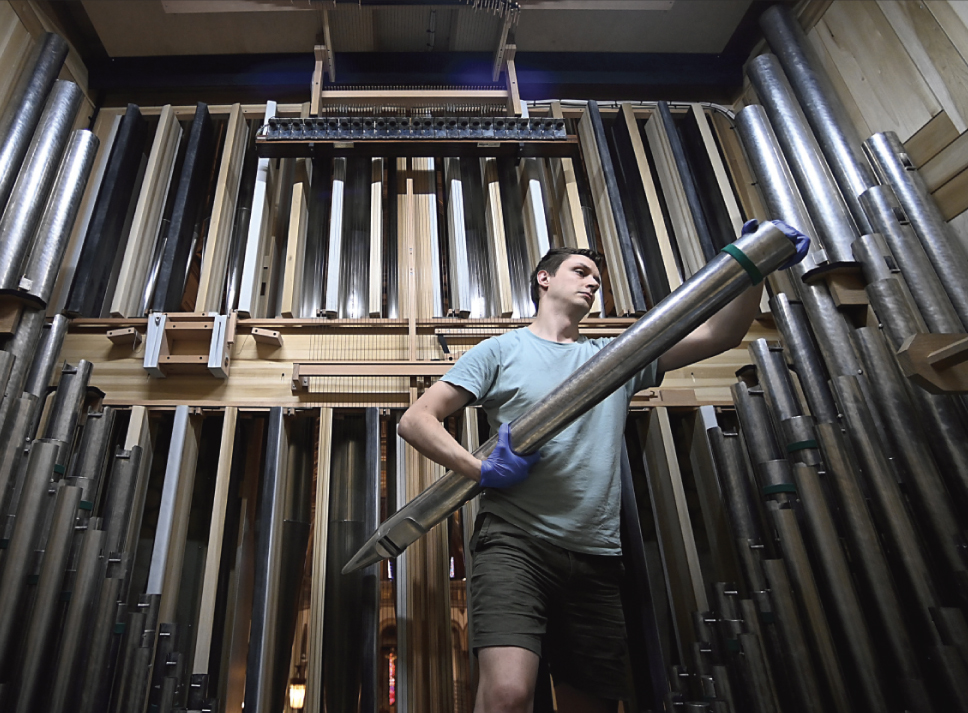
Alex Ross adjusts a pipe in the gallery organ. (photo: Alexa Welch Edlund)
To achieve this degree of flexibility while maintaining coherency, we needed to strike balances between traditions on the macro- and micro-scale. On the macro level, the Récit is very symphonic, boasting strings, harmonic reeds, gambas, color reeds, and harmonic flutes galore.
The Positif leans much more classical, with its articulate principal chorus, flute mutations up to 1′, a North German–inspired Trumpet, and an uncompromising 18th-century French Cromorne. The Dulciane, Unda Maris, Cor Anglais, and Quintaton are chameleons that can be used to great effect in music from many different eras.
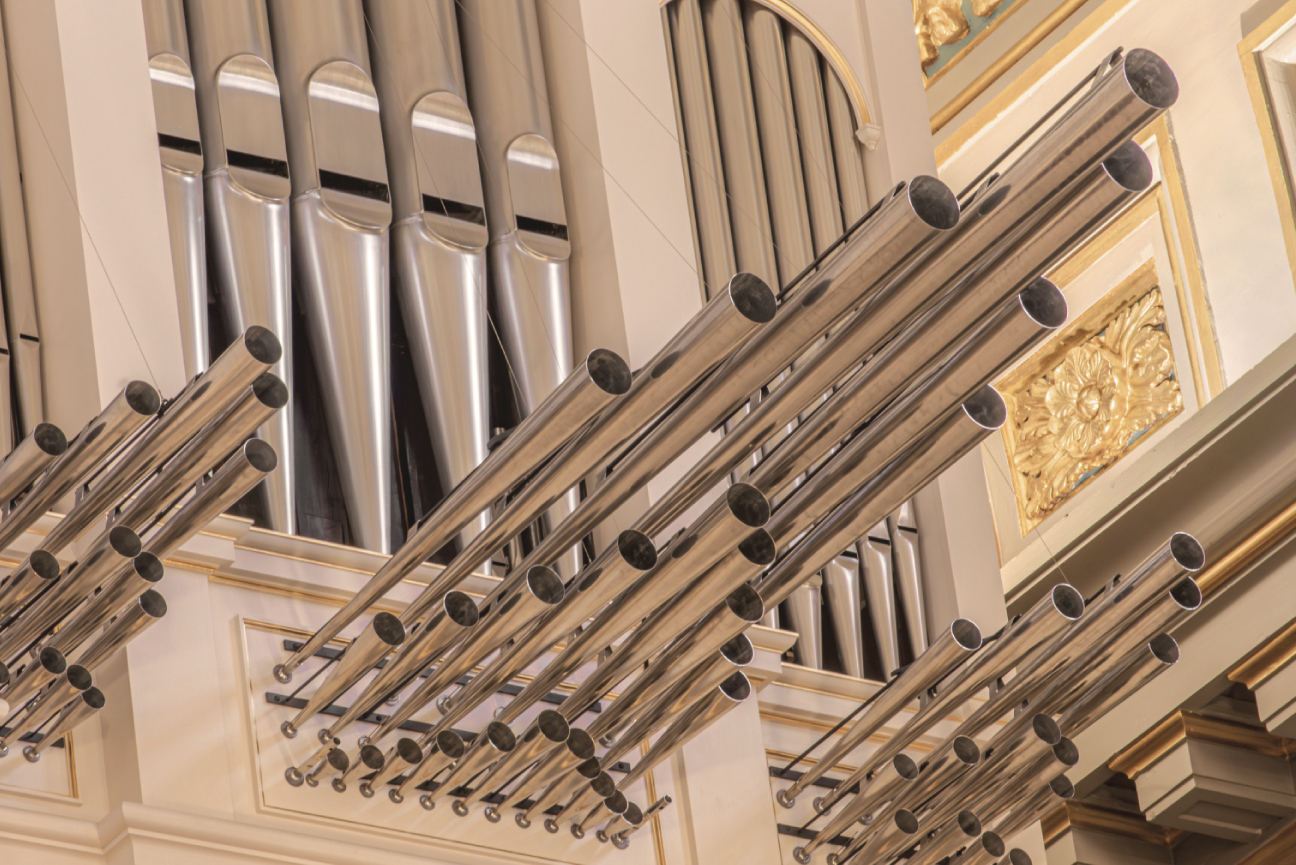
View of the 16′ Montre and chamades (photo: Robin Côté)
The Grand-Orgue and Pédale have one foot in each camp. The 16′ and 8′ Montres are slotted, with a progressively smaller proportion of overlength as they ascend into the trebles. This concept continues right into the mixtures, which are almost entirely cone-tuned. Similarly, light nicking in lower principals transitions to virtually no nicking in the Doublette and the mixtures. This allows the organist to have their four creamy 8′ fonds—and a sparkling and articulate principal chorus. The slotting brings directionality to the basses, while coned trebles are more lyrical than a true symphonic organ (more coloratura).
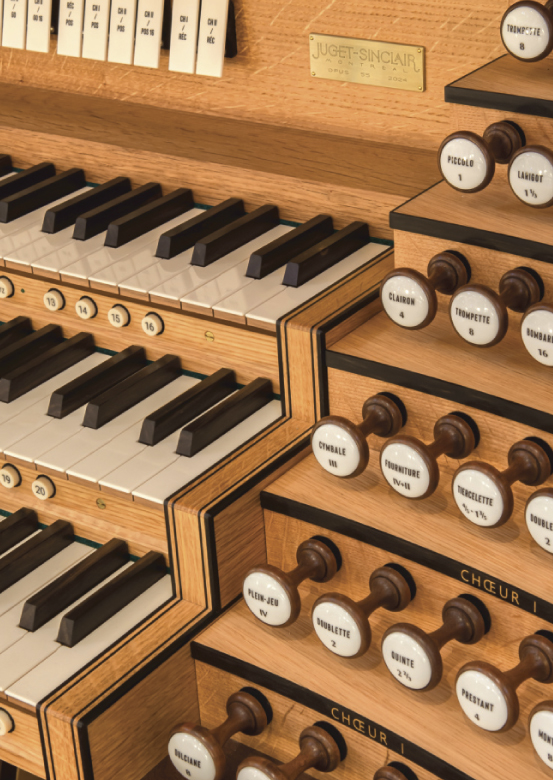
Console details: key cheeks and stop terraces (photo: Robin Côté)
We couldn’t dream of a more solid foundation for Opus 55 than the 32′ Principal-Basse. For us, this is one of the most versatile stops of the entire organ: it can accompany the celestes, a Germanic plenum, a fond d’orgue, and the tutti. It takes the liturgy to the next level!
The reed batteries of the Grand-Orgue and Pédale are based on late 18th-century French models both in construction and voicing. They are assertive, but they do need to be able to fill a cathedral after all.
Available on all manuals and pedal, the two chamades are very different from one another. The 8′ Trompette-en-Chamade is French and round; it brings definition while still being able to blend into the tutti. The 4′–16′ Chamade, on the other hand, has a much more Iberian character and breaks back from 4′ to 16′ at middle C. It is rustic and exhilarating and opens musical possibilities that are seldom explored in the United States or Canada.
Try as we might to describe the sound of this organ, we sincerely hope that you will have the opportunity to hear Opus 55 for yourself!
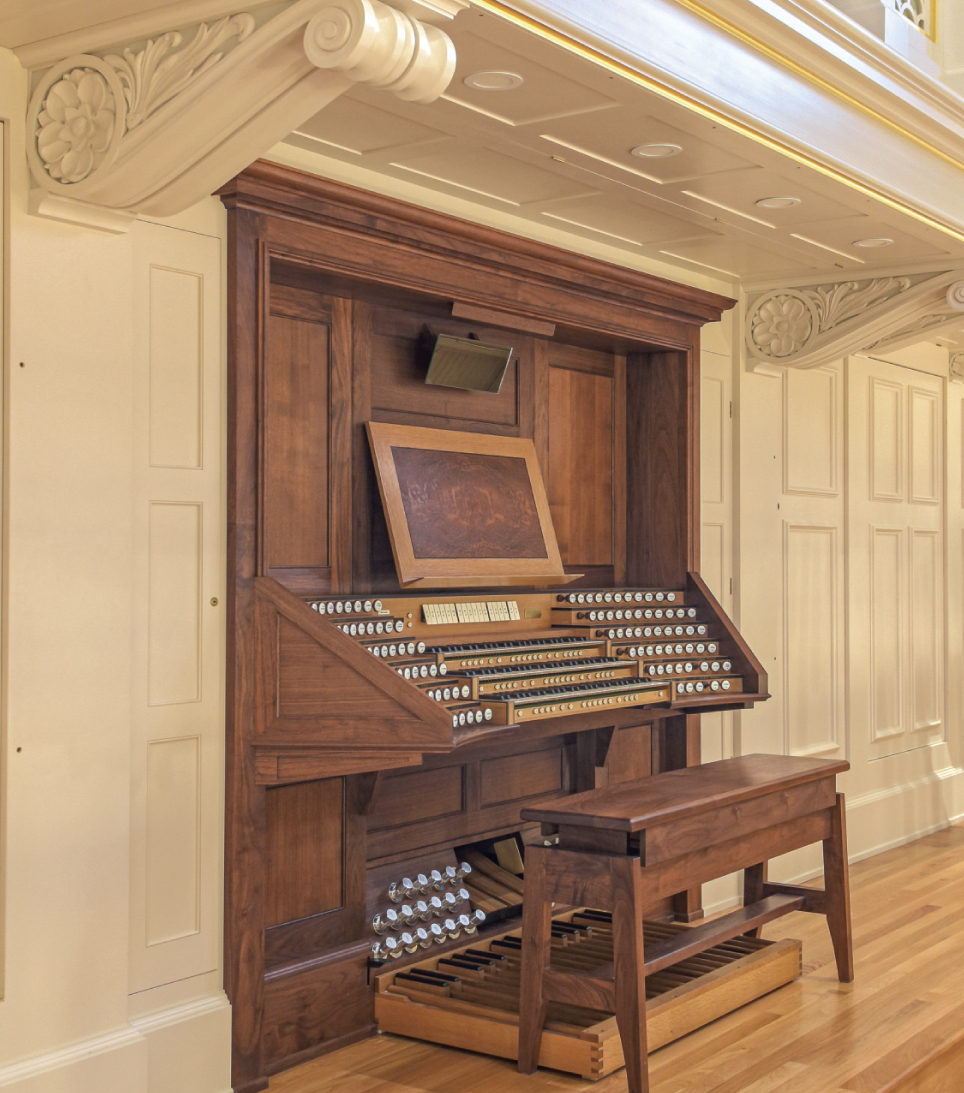
Console and surrounding casework (photo: Robin Côté)
Conclusion
It has been our honor and privilege to conceive and build this organ for the Cathedral of the Sacred Heart. After two years of dedicated, hard work, it brings us great joy to see our Opus 55 assuming its place as a part of the cathedral community: after all, an organ is not for just one person! We would like to thank Carey Bliley, Daniel Sáñez, Kim Kremer, Paul Thornock, Fr. Anthony Marques, and the Cathedral Foundation Board. There are so many others, too long a list to include here.
Juget-Sinclair Organbuilders
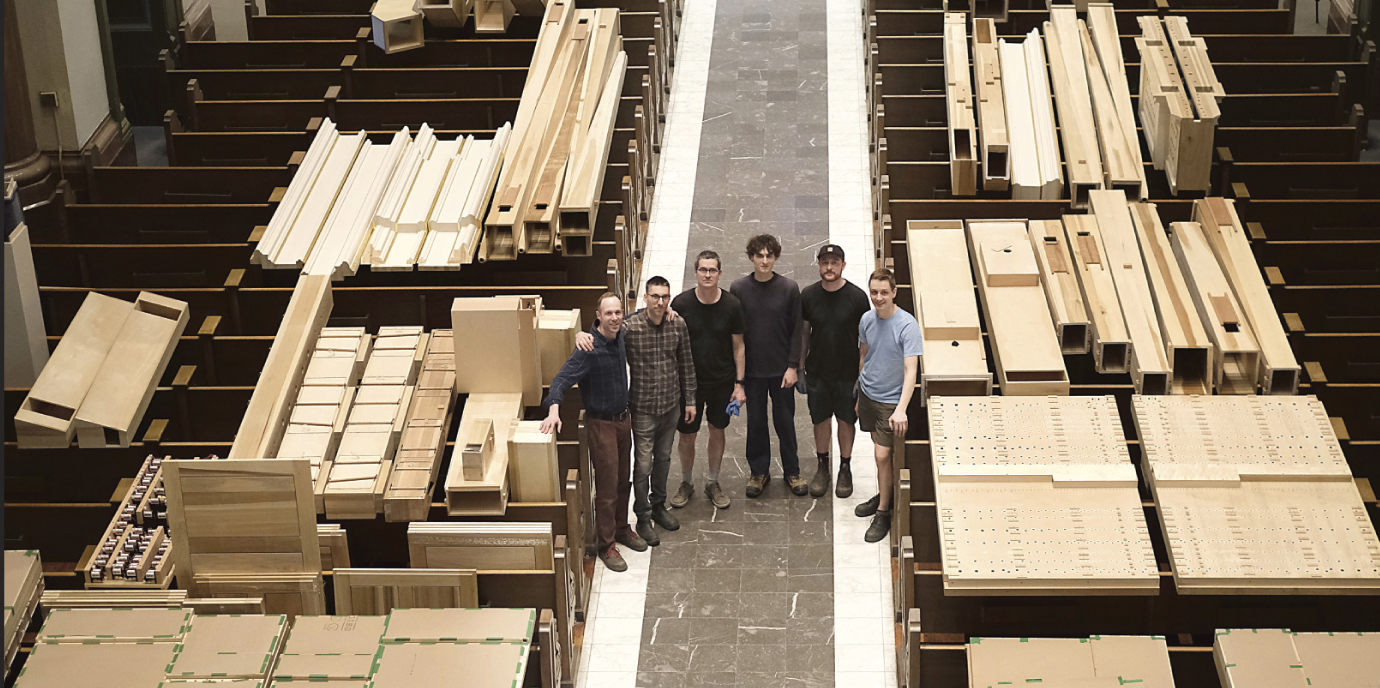
Juget-Sinclair installation team posing amid the detached organ parts resting on the pews (photo: Alexa Welch Edlund)
Juget-Sinclair Organbuilders
Robin Côté, President
Stephen Sinclair, Vice-President
Clément Bodart
François Couture
Théodore Dupuis
Dean Eckmann
Jean-Dominique Felx
Denis Juget
Alexis Kelly
Michal Michalik
Alexander Ross
Graham Webb
Philipp Windmoeller