DECEMBER 2025
Curtis Institute of Music
Philadelphia, Pennsylvania
Dobson Pipe Organ Builders
Lake City, Iowa
From Curtis
When I began teaching at Curtis in 2002, I made it known to our dean that I would like the school to consider a new instrument. Our Aeolian-Skinner, Opus 1022, had trained countless leading organists since the late 1930s. Yet it had become increasingly unreliable, and its sound had begun to suffer. It was an organ that required magic tricks in order to approximate authentic and appropriate musical effects, and it was time for an instrument that didn’t demand sorcery. Maintaining and upgrading facilities to support our student needs at the highest level possible has always been a strong Curtis priority, but the school had just signed a contract for significant work to be done to the organ, requiring me to wait it out. In the meantime, I expanded practice facilities and organized organ scholar positions and study trips while I waited for the right time to begin making noise again.
Fast-forward 15 years or so. As the organ began to fail in multiple ways at the worst possible times (such as auditions and graduation recitals), I had the opportunity to approach the school and express the department’s desperate need for a new teaching and concert instrument—one that could put Curtis on an equal footing with our peer institutions. I was given the green light to form a committee and begin work to determine precisely what was needed.
I turned to fellow Curtis alums Ken Cowan, Matthew Glandorf, and Nathan Laube, and we all brainstormed over the course of a few years. Their understanding of the Curtis tradition, their knowledge of local organs we have access to as well as instruments worldwide, and the respect they command in performance and pedagogy made them a dream team. With so many fine companies from which to choose, Dobson was ultimately selected after we heard instruments they had built in similar acoustical situations.
While I steered the discussion about the organ’s tonal character toward repertoire typically taught in our curriculum, the final specification was born out of numerous conversations. It was drafted by Nathan Laube, then tweaked and refined in discussions with Dobson. Their familiarity with the historic instruments that inspired the specification was crucial to fulfilling our desires and ensuring the organ’s ultimate success. The end result is a new instrument that, while almost 40 ranks smaller than the previous one, will support a far wider range of repertoire.
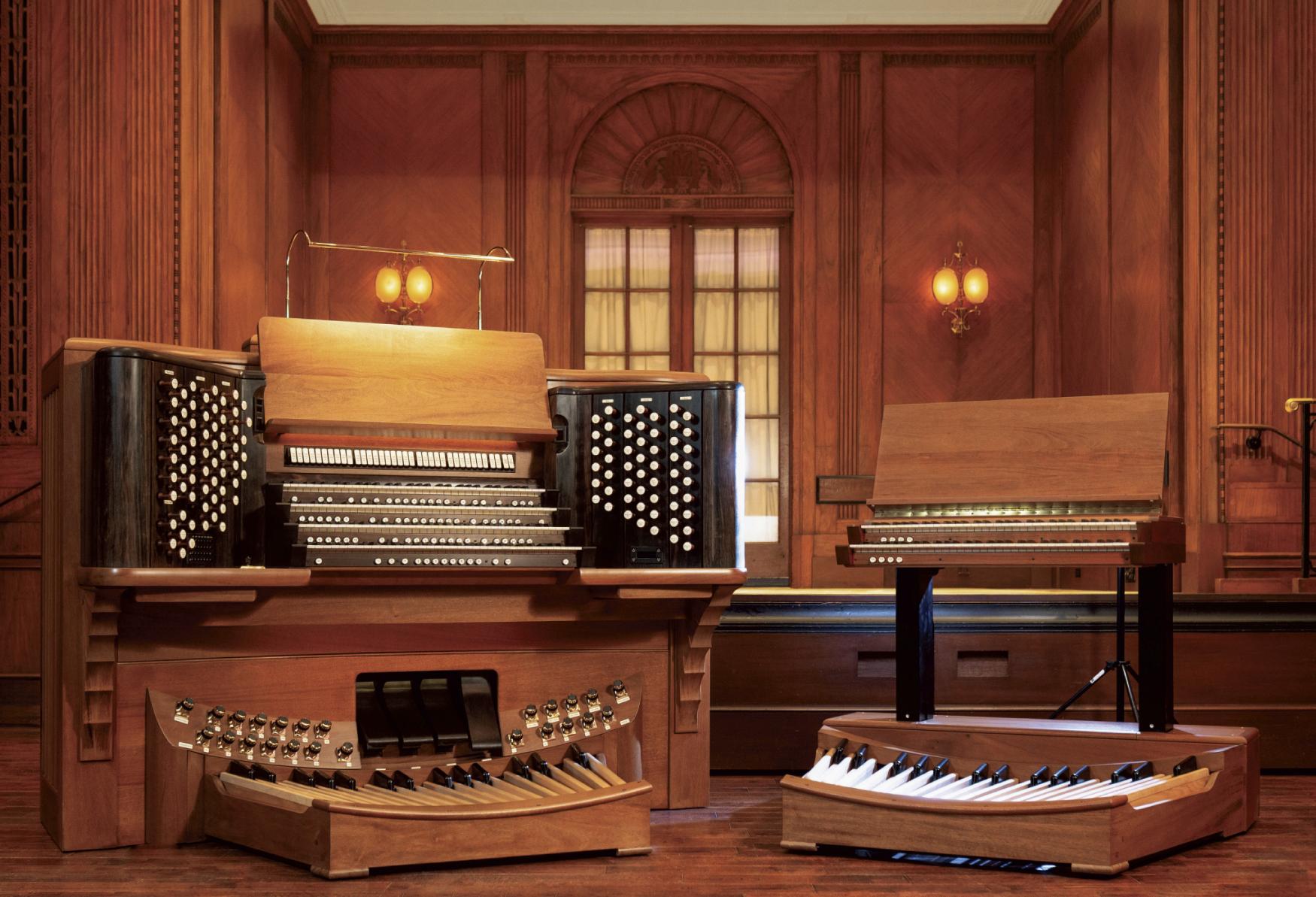
The teaching console (right), designed to save time and energy in private lessons
The organ is used regularly in collaboration with instrumentalists and singers, so having a fully expressive instrument is an added bonus, as it enables the achievement of maximum musical effect. I think the only unusual request from me was a teaching console where I could sit during lessons and demonstrate without having to waste minutes of valuable time moving students off the bench. Dobson didn’t flinch at this unique request and came up with a brilliant and compact design.
I am grateful beyond words to all the donors who have made this possible, and to the school for supporting this effort every step of the way. Our facilities team, headed by Steve Casciano, has gone above and beyond in everything from the removal of the old instrument to the smooth installation of the new one. I am grateful to John Panning and the whole Dobson team for creating this organ, which will serve many future generations of Curtis students.
Alan Morrison
Haas Charitable Trust Chair in Organ Studies
Curtis Institute of Music
From Dobson
“I would never build an organ for a situation like that,” one of my organbuilding colleagues flatly told me. The organ space in Field Concert Hall, a 240-seat venue added in the 1920s to two connected 19th-century mansions, is no builder’s ideal. The chambers, primarily in the ceiling with an extra space at stage right, seem designed to defy any traditional expectations of organ design—this even in the Roaring Twenties, when no attic, closet, or basement was deemed too remote for placing pipes.
The first organ was built, appropriately enough, by the Aeolian Company, perhaps because of their long experience inserting organs into tricky residential settings, perhaps on account of an existing relationship to Cyrus H.K. Curtis and his daughter, Mary Louise Curtis Bok, who founded the Institute in 1924. How exactly Aeolian managed to shoehorn their four-manual Opus 1625 of 1928 (48 ranks, seven 16′ stops, Vox Humana Choir, Harp, and Chimes) into this space remains a mystery.
Not even a decade later, in 1937, G. Donald Harrison and Aeolian-Skinner added a then-exotic Positiv, a 32′ Fagotto, and a new five-manual console. In 1941, Aeolian-Skinner returned to replace the rest, retaining the Harp, Chimes, and 14 ranks from the Aeolian. Now 91 ranks, the organ grew to 106 in Möller’s 1974 rebuild; in 1999, Robert Turner supplied a new console, the fourth in eight decades. Disorganized as a result of this evolution, the organ had become difficult to tune and service. From the player’s standpoint, space constraints had forced the tonal design into musically unhappy choices, such as short-length reed basses and a general lack of low Pedal voices. Key stops seemed to live in the wrong places or have unlovable character, affording students the dubious lesson of how to turn the organ upside down to make repertoire sound tolerably musical.
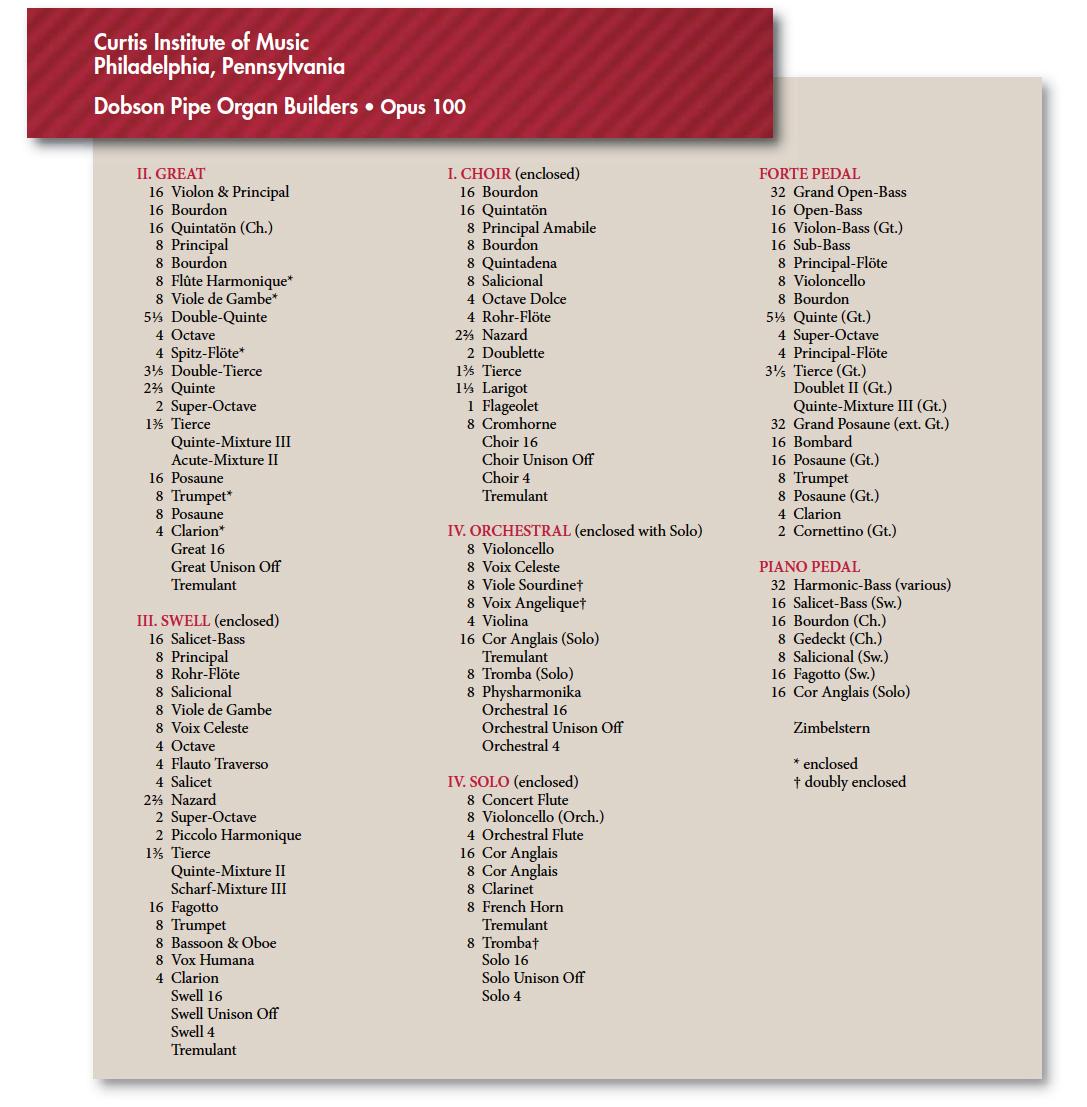
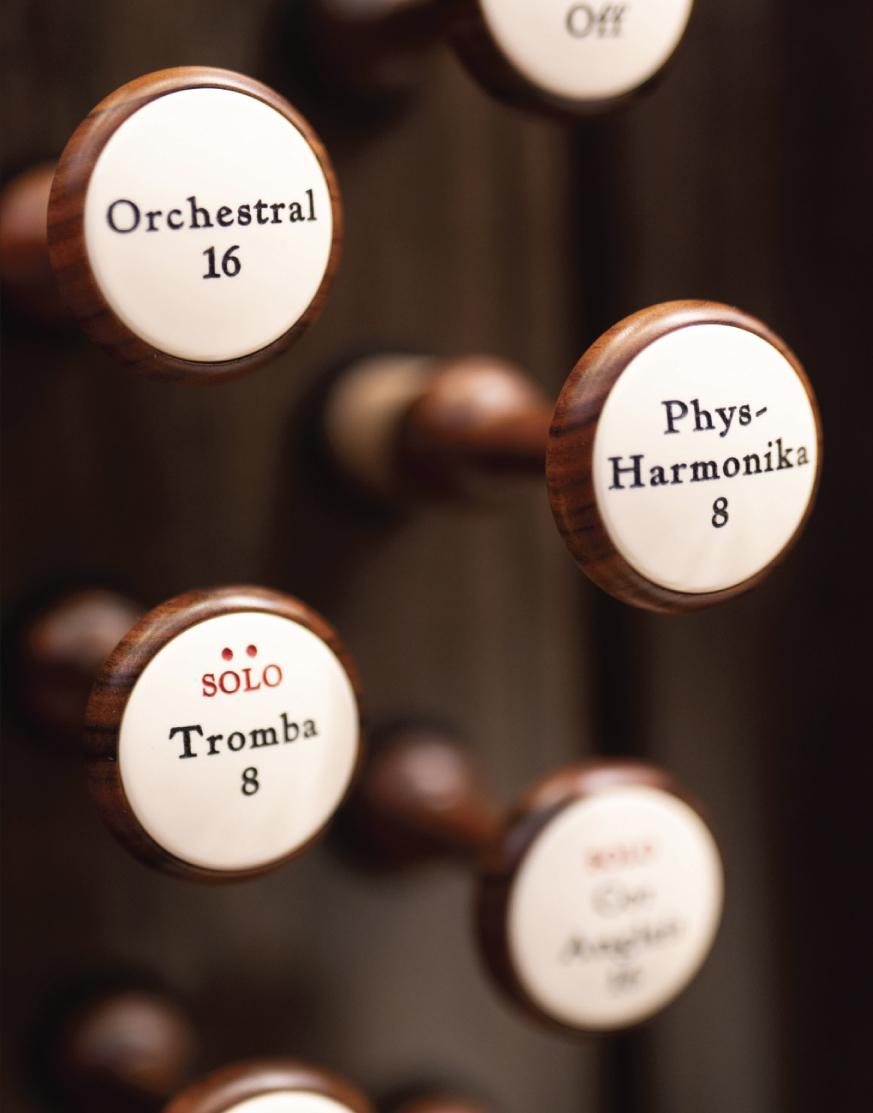
Working with Curtis’s organ committee, we devised a specification that draws inspiration from 19th-century American and central European instruments. Mindful of Philadelphia’s rich organ heritage, Opus 100 doesn’t attempt to provide features already found in abundance in nearby instruments. Instead, it forges its own path by exploring the 19th century’s love of color and dynamic contrast—a “grand salon” aesthetic that’s well suited to Field Hall’s modest space and dry acoustic. Great, Swell, and Choir have expected chorus elements but also layers of colorful, unassertive unison tone. The reeds draw from French, German, and American traditions, while multiple tierce registrations extend solo and ensemble possibilities. An unusual feature is the Physharmonika, a harmonium-like stop fitted with a Windschweller to regulate the air pressure; between this and a movable lid over its free reeds, its sound can be reduced to inaudibility. Duplexing and extensions, features that 19th-century builders were beginning to incorporate, provide versatility, and all manuals save the Great have 73-note windchests for further exploration. Mindful of the intimate surroundings, the voicing emphasizes richness, clarity, and color—a feast on mezzo terms.
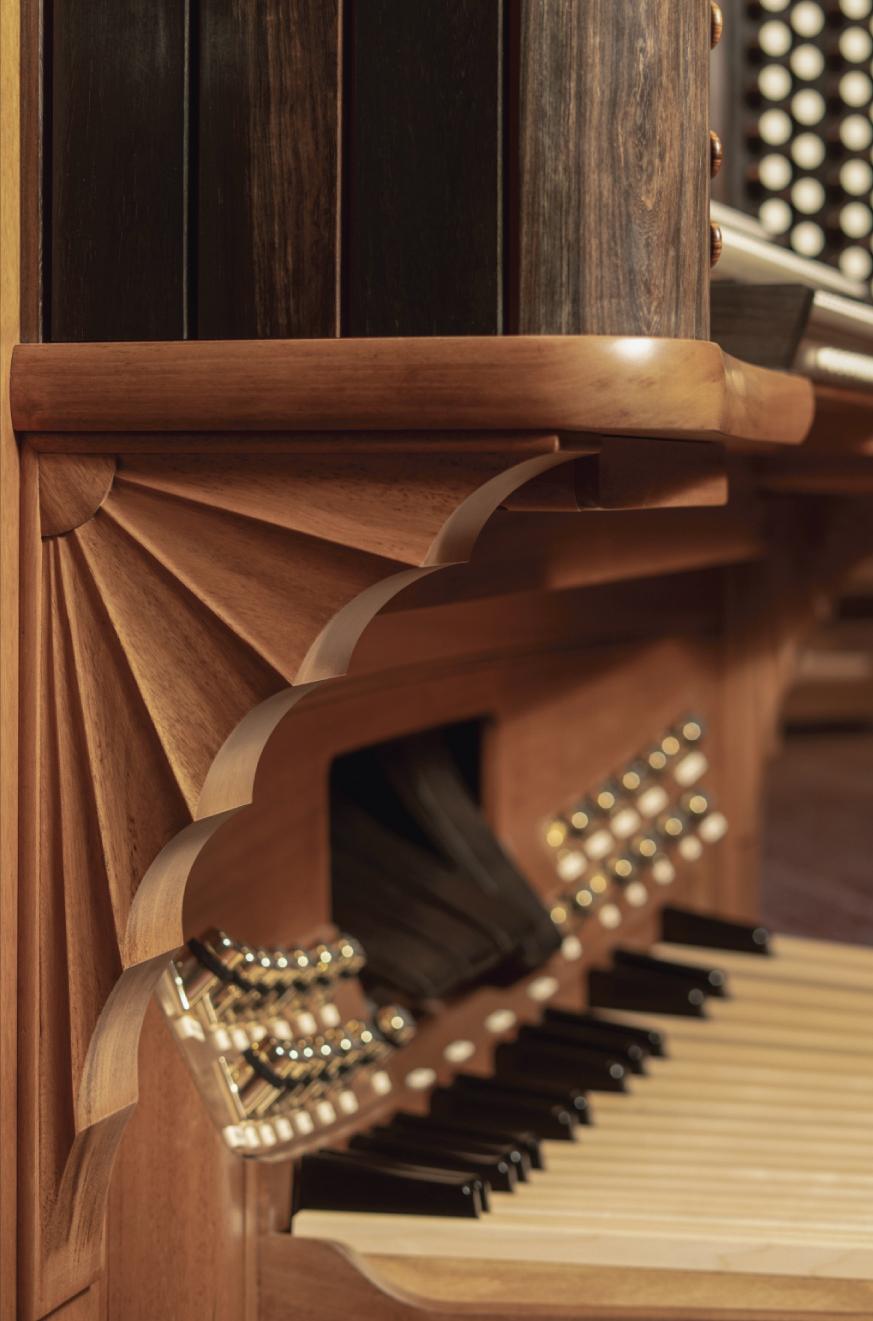
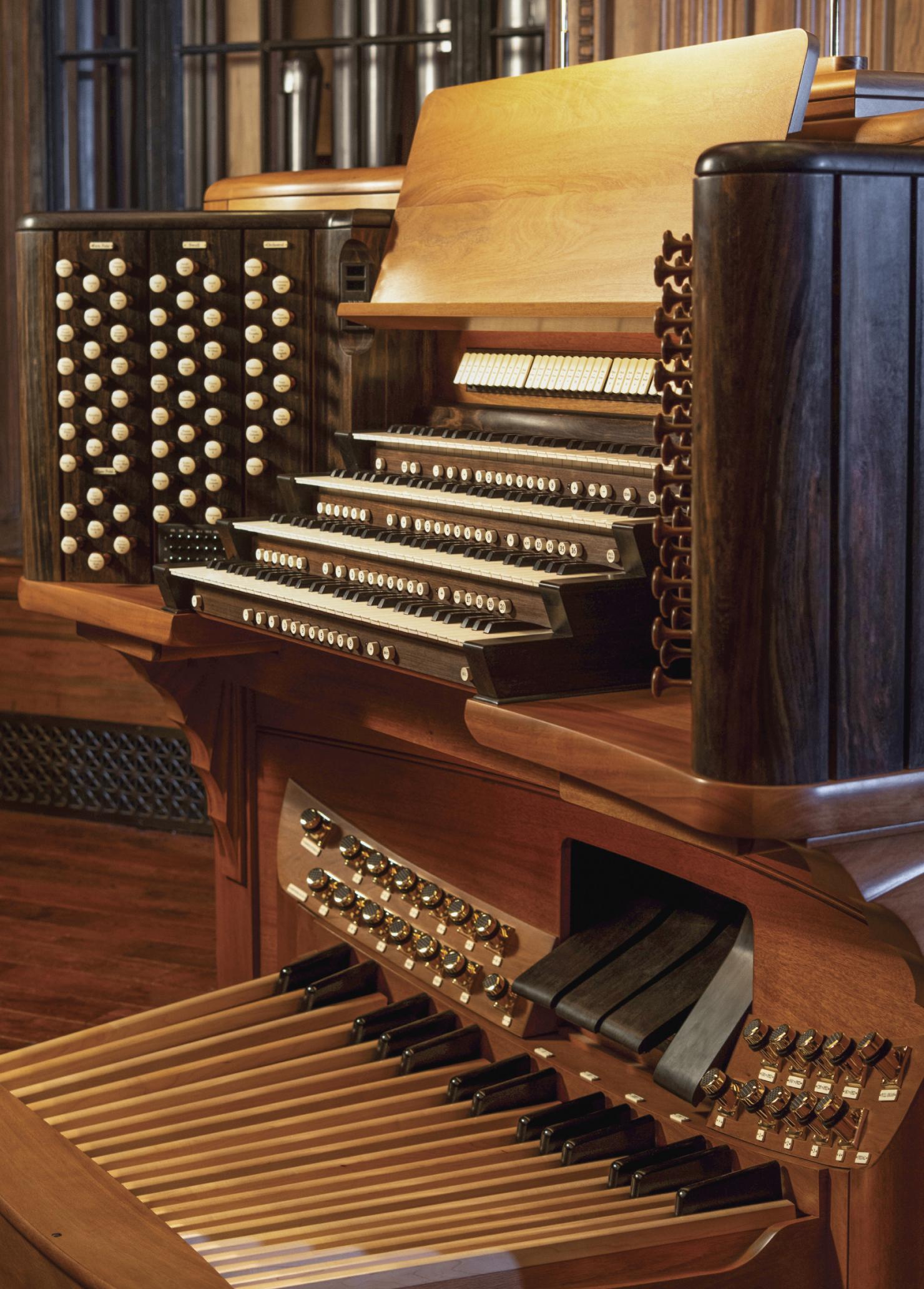
Enclosure is an important part of the design. Except for the Pedal and part of the Great, everything is enclosed. The Solo and Orchestral share an enclosure; the Viole Sourdine, Vox Angelica, and Tromba are doubly enclosed. Since there are seven features that require control by shoes (Enclosed Great, Swell, Choir, Solo/Orchestral, Inner Solo/Orchestral, Physharmonika Windschweller, and Crescendo), a settable expression matrix is provided to assign these functions to any of the four shoes, with indicators for each feature. In addition to the usual combination action features, the console also includes a sostenuto function for each manual, permitting pencil-free performance of modern and improvised music.
In many ways, the new organ follows the physical arrangement of its predecessor. The Great and most of the Pedal stand in the chamber above the stage-right seating area, speaking relatively directly through the chamber’s lunette grille. Swell and Choir stand above the hall ceiling, their windchests being several feet higher in elevation than those of the Great and Pedal. Thus, sound from these departments makes a 180° turn through the Great and Pedal chamber on its way to the grille. The Solo and Orchestral are placed on the opposite side of the hall and have relatively direct egress. As the only tall space, the former stage-right Positiv chamber now contains the largest Pedal pipes.
Slider windchests have a beneficial effect on pipe speech, particularly on lower wind pressures, with the added advantage of compact treble spacing. For these reasons, we’ve employed them in the Great, Swell, and Choir. One of the Great windchests has duplex mechanisms permitting certain Great stops to play in the Pedal. Stops on higher wind pressures, very large pipes, and ranks that play in multiple divisions or at multiple pitches speak from electropneumatic windchests—essentially the Solo, Orchestral, Pedal, and all offset bass pipes.
As we designed the organ, we drew on the experience of building our Opus 96 for Bruton Parish Church in Williamsburg. In that instrument, pipes above the ceiling are voiced on higher wind pressure than those below. In Field Hall, the limited height means that the basses of five 16′ stops are installed horizontally. This organ contains more Haskell pipes—186—than any previous Dobson. Thanks to careful planning, every pipe is easily reachable for tuning, and every mechanism is readily serviceable.
A project this complex represents the work of many hands. In addition to my talented coworkers, we were assisted by Sapsis Rigging Inc.; by Ortloff Organ Company and Joe Sloane Pipe Organs, who collaborated to rebuild the blower room and restore the Spencer blower; by Richard Frary of Czelusniak et Dugal and Sean O’Donnell, who assisted with the installation; and by John Ourensma and Don Glover, both Dobson alumni, who supplied their expertise during tonal finishing.
I have long admired the 19th century’s quieter side, especially those stops seemingly out of step with many of today’s perceived musical needs—sounds that seem to exist for nothing other than to surprise and delight the listener. Working with this organ and these excellent musicians has allowed our team to explore this love in challenging and rewarding ways. And of course, there is also the privilege of working for such a venerable institution, with such a storied past and a clearly exciting future. We trust that Opus 100 will help Curtis celebrate not only its centennial but also many decades of fruitful teaching and music.
John A. Panning
President and Artistic Director
Dobson Pipe Organ Builders