SEPTEMBER 2025
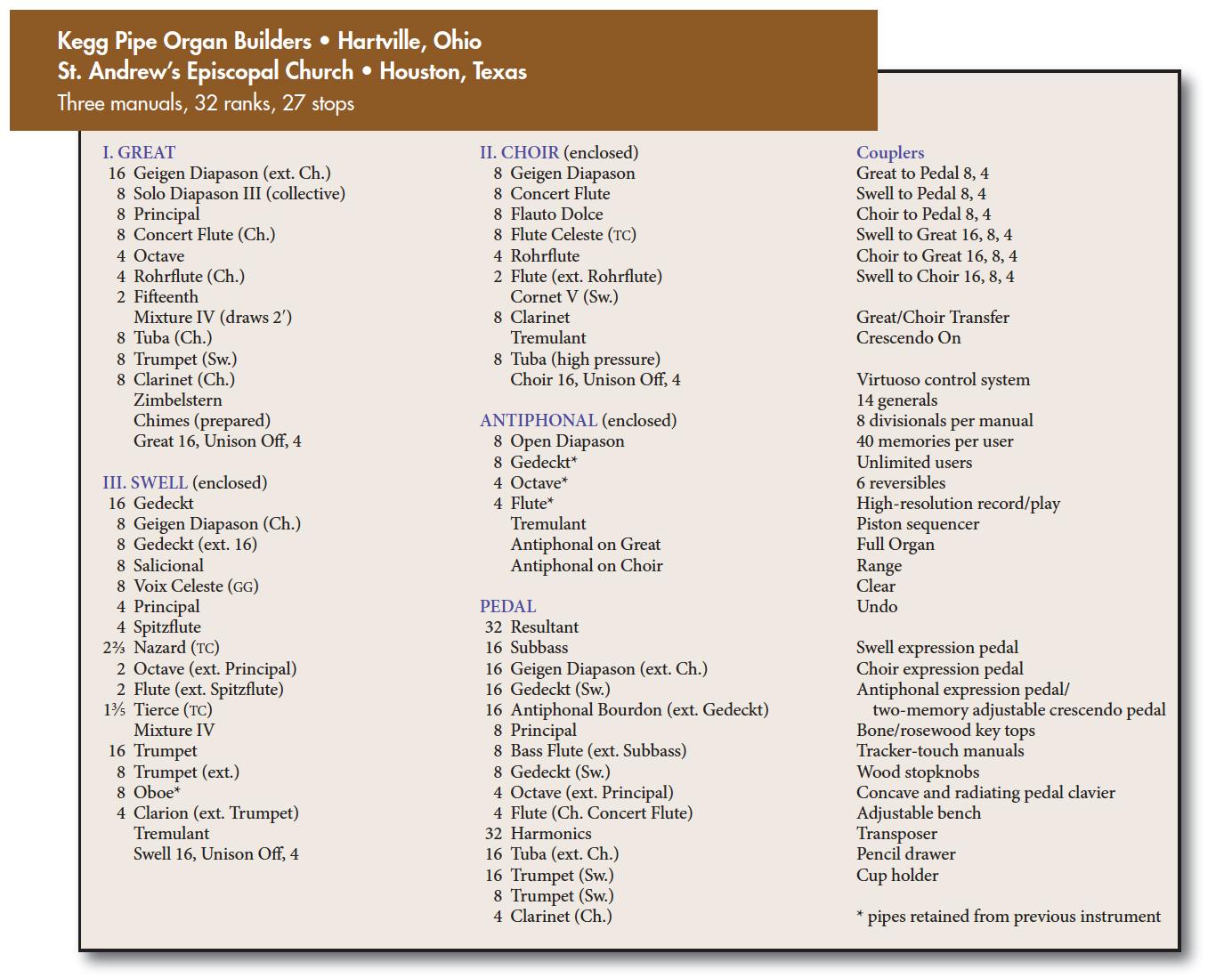
Kegg Pipe Organ Builders
Hartville, Ohio
St. Andrew's Episcopal Church
Houston, Texas
.jpg)
Console in the Kegg shop
From the Director of Music and Organist
Founded in 1911, St. Andrew’s Episcopal Church is nestled in the historic, tree-lined neighborhood of the Heights in Houston. When I arrived ten years ago, I was delighted to find a welcoming congregation that values elegant liturgy (without being fussy) and robustly sings hymns, service music, and psalms. In the 1990s, after saving for a pipe organ for decades, the parish installed a 1909 Pilcher augmented with several ranks of vintage pipework. Due to space constraints, the 13-rank instrument was entirely enclosed in the gallery above the narthex, while the choir and console remained in the chancel. Despite good pipework and excellent voicing, the distance between the gallery and the chancel made it difficult to balance the organ with the choir and congregation.
When the instrument incurred significant maintenance costs in 2019, I started exploring the possibility of rebuilding or replacing it and moving it to the chancel, where it could better support the liturgy. And when the parish decided to launch a capital campaign—“Our Vision, Our Hope, Our Legacy”—in 2022, the organ project became central to that undertaking.
.jpg)
My first conversations were about acquiring a mechanical-action instrument for St. Andrew’s. My life as an organist began with playing for the Episcopal liturgy, hand-registering a beautiful 24-rank tracker in a generous acoustic, and I spent graduate school playing exquisite mechanical-action instruments, so I was completely sold on their merits when I began talking to builders.
But given the space and budget limitations at St. Andrew’s, I soon realized that mechanical action would give the parish a limited specification and necessitate a less-than-ideal placement in a dry acoustic. Above all, I wanted the church to have an instrument that would elevate the liturgy, so I began talking with a more diverse range of builders. After receiving excellent proposals from three first-class firms, the organ committee and I unanimously selected Kegg Pipe Organ Builders.
I had heard several of Charlie’s instruments—from 12 ranks in a dry room to 76 ranks in a very live room—and each boasted careful and beautiful voicing, liturgy-centered stoplists, and judicious use of borrowing. The organ committee was very impressed with his instrument at Church of the Little Flower in St. Louis—although I did caution them to ignore the luxurious acoustic there. Furthermore, Charlie’s solution to the severely limited space at St. Andrew’s provided a concept that made it seem as if the chancel of the 1946 building had been constructed with an organ in mind.
Our new instrument has a variety of foundation tone and can support congregational singing at many dynamic levels while also successfully accompanying the choir, from the voice of a single child to the rich sound of the combined ensembles. It has a diverse collection of reeds that can add color to ensembles, command a strong solo line, or sing out a gentle melody.
.jpg)
Console detail
I’m also proud that this project has allowed St. Andrew’s to recover a triptych of stained-glass windows celebrating the twelve apostles that was obscured by the previous instrument. Furthermore, the resplendent rose window above the altar was lowered to sit just above the unenclosed Great case, where it is now easily seen.
The Antiphonal division is enclosed in a new chamber to the side of the narthex stained-glass triptych and will help pull the sound of the chancel instrument into the room. Aside from the 8′ Principal, it uses pipework from the previous Pilcher instrument. While this organ project was funded entirely by the parishioners of St. Andrew’s, two families generously gave additional funds for the Antiphonal organ, the Zimbelstern, and the custom tracery on the console, which matches that found throughout the church.
Because of the vision and dedication of our rector, our organ committee, and the entire parish, as well as Charlie Kegg’s creativity and skill, St. Andrew’s will continue to be a welcoming church that seeks through art and music to offer praise and thanksgiving to God.
John Kirk
.jpg)
Choir 16′ pipes being installed
From the Builder
A wise and fortunate pipe organ builder evolves throughout his career. I have always sought to build instruments that, while rendering all music convincingly, excel at playing American church services by supporting timeless choral works and graciously leading hymns. When I started my company in the 1980s, I felt that the organ style that best suited this goal would be warmer and more Romantic than was generally favored at the time. I set out to build musical organs that were satisfying to play and to hear, using the best available technology, whether new or ancient. Our new organ at St. Andrew’s showcases how the Kegg style has evolved, and it has everything that is important in a modest instrument for a complex and diverse music program.
When I began talking with the committee, their idea was to place the organ at the side of the chancel. Yet I quickly realized that the instrument they were hoping to have would not fit in this space well, and I felt it was a shame that the lovely rose window above the altar was almost entirely hidden behind the roof trusses. There were also suggestions of organ chambers at the sides of the altar being used for closets. With all these elements in mind, we developed a proposal to enlarge the side chambers to a usable size, lower the rose window, and replace the altar with a new organ case. I proposed this with some trepidation, as such suggestions can be cause for ejection from the building. But with the benefits of actually seeing the lovely window and being able to incorporate needed elements of the altar into the new case, the committee came to appreciate the proposal, and we continued down this path. The center case provides a tabernacle and shelves for candles, which had been the primary use of the previous altar. This new case also has the Christus from the original altar as its main focus. The structure seems as though it has always been there.
.jpg)
Great case under construction
Musically, the organ supplies all the elements needed for an American Episcopal choral program, at a scale commensurate with the building size, as well as the resources needed for most organ literature to be played compellingly. There are several items of particular note. The 16′ Tuba is based on an E.M. Skinner example; it is rich, powerful, and smooth, and becomes a mezzo piano solo voice behind the Choir shades. The Flute Celeste floats by the listener as aural incense. The Solo Diapason provides the effect of a First Open Diapason by drawing three principal stops—Great Principal, Great Octave, and Pedal Principal—at 8′ pitch. It is quite enchanting in this setting.
.jpg)
Swell pipework
.jpg)
Choir pipework, with Tuba on left
It is our hope that this organ will serve this thriving congregation for generations to come. I would like to thank music director John Kirk particularly, as his friendship and enthusiasm have been evident in all of our discussions, from the beginning of this project to its conclusion.
Charles Kegg
Kegg Pipe Organ Builders
Spencer Bean
Philip Brown
Michael Carden
Justin Dana
Joyce Harper
Philip Laakso
Bruce Schutrum
Paul Watkins